Is the grid method cheating? No. A grid solves one narrow problem, where things go on the surface, and leaves every problem that makes a painting good entirely to you. It does not mix a color, choose an edge, or make a single mark. Artists have used grids for over 3,000 years. The honest version of the objection is not about the grid at all. It is about which skills you want to build, and that is a real question worth answering carefully.
This question shows up in every art class, every forum thread, every comment section under a gridded drawing. It deserves better than a defensive “no.” So let us take it seriously, find out what the objection is really made of, and then answer it.
What people actually mean when they say “cheating”
Start by being fair to the objection, because there is a real one hiding inside it. When someone says the grid is cheating, they almost never mean it literally. They mean one of three things, and they are not the same.
The first is about skill. The worry is that the grid does the hard part for you, so you never develop the ability to see and place proportions by eye. There is something true in this, and we will come back to it, because it is the only version of the objection with real weight.
The second is about originality. If you are copying a photograph square by square, the worry goes, where is the art? You did not invent the image. You transferred it.
The third is about “real seeing.” Drawing is supposed to train your eye. The grid, the worry goes, lets you bypass observation. You are reading coordinates off a chart instead of looking at the world.
Three different objections, wearing the same word. They have different answers, so it helps to separate them before answering at all. Strawmanning the question, pretending it is just insecurity, is the lazy move. The question is reasonable. It just dissolves under inspection, and watching it dissolve is more useful than dismissing it.
What the grid actually does
Here is the whole of what a grid does. It divides your reference into squares, you divide your surface into matching squares, and now placing a shape correctly on a large surface becomes placing a small shape inside a small square. That is it. That is the entire mechanism.
What does it not do? It does not mix your colors. It does not tell you how hard or soft to make an edge. It does not decide which details belong and which to leave out. It does not give a line its quality, the thing that separates a living contour from a dead one. It does not create the sensitivity that separates a painting from a photocopy. Every one of those decisions still happens inside the squares, and every one of them is still entirely yours.
So the grid solves exactly one thing: placement. And placement, of the problems in painting, is the least interesting one. Getting the eyes two millimeters too far apart does not make a portrait more expressive. It makes it wrong. Proportion is a problem you want correct and then forgotten, so your attention can go to the problems that actually carry the feeling. The grid is a way of spending your attention deliberately. It buys back the time you would have spent measuring, and lets you spend it on color and edge and emphasis instead.
That reframes the skill objection completely. The grid is not removing skill from the work. It is moving your skill to a different part of the work.
The objection answers itself in history
If the grid were cheating, the history of art would be a history of cheats, because the people who used it are the people who define the skill.
Leon Battista Alberti, in his 1435 treatise On Painting (De Pictura), recommended a device he called the velo, a thin veil divided into squares by threads, stretched in a frame and placed between the artist’s eye and the subject. Looking through it, the painter saw the scene divided into cells and copied each cell onto correspondingly gridded paper. Alberti did not present this as a crutch. He presented it as one of the foundations of the craft, in the section of his book on the basics of drawing itself.
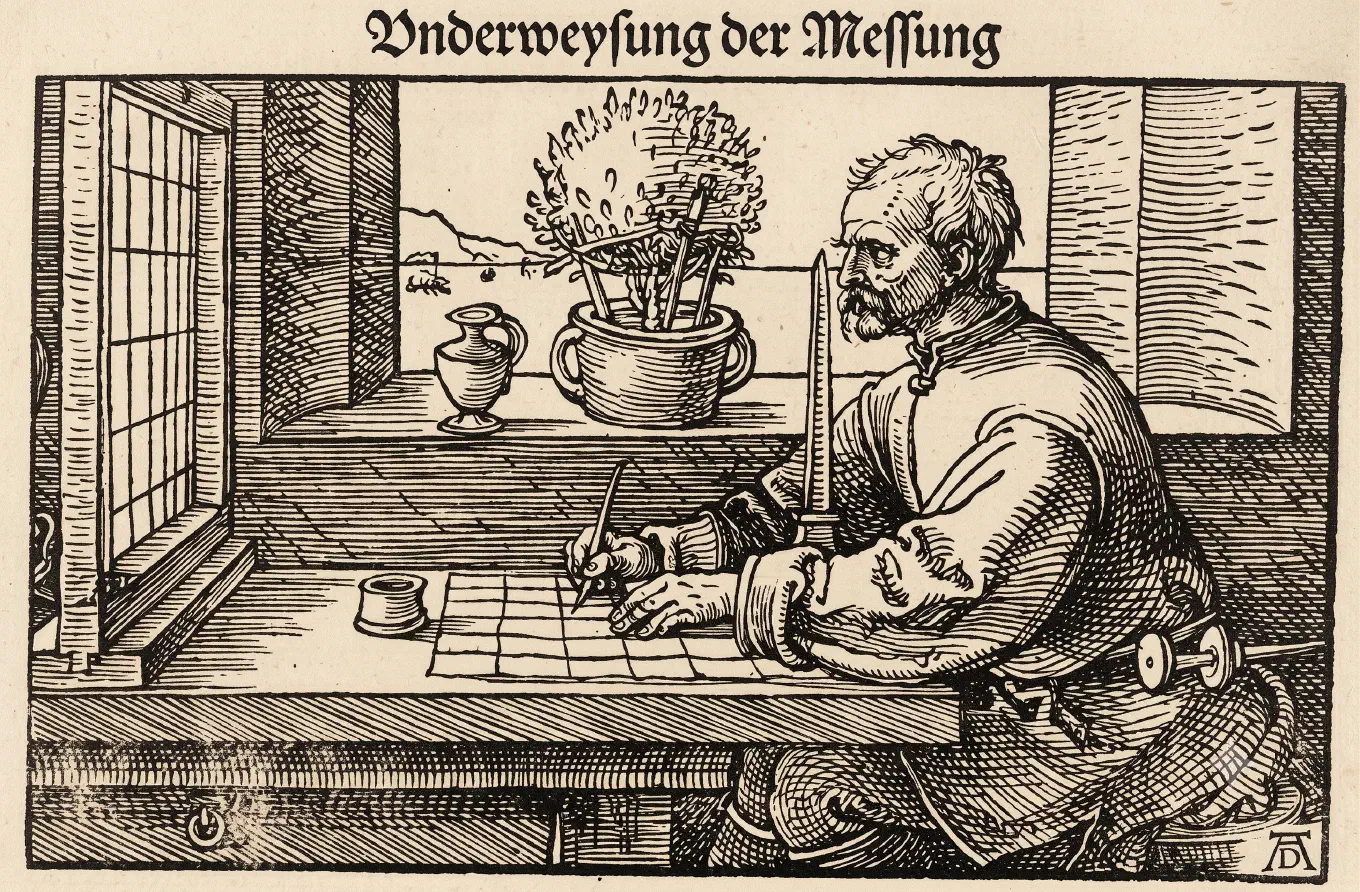
Albrecht Dürer went further. In his 1525 treatise Underweysung der Messung, he documented several drawing machines, the most famous being a frame strung with a net of threads placed between the draughtsman and the subject. His woodcut Draughtsman Making a Perspective Drawing of a Reclining Woman shows the device in use: the artist looks through the gridded frame and transfers what he sees, cell by cell, onto a gridded sheet. Dürer published these as instruction, openly, for other artists to use.
Then there is Chuck Close, who did not hide the grid as a preliminary step but made it the visible structure of nine-foot portraits, filling each cell one at a time across a fifty-year career. Renaissance and Flemish workshops used gridded veils to scale small studies up to large finished works, a routine practice called squaring up. Norman Rockwell projected. Richard Estes gridded. None of these names belongs on a list of people who avoided skill. They are the list of people who had it.
The romantic idea that “real” artists work with nothing but a pencil and a steady eye is a specific historical attitude, mostly from the 19th-century academies, not a timeless law. It is one chapter in a much longer story, and for most of that story, transfer tools were standard equipment, used in the open, by the best.
Where it gets genuinely interesting: the optics debate
The strongest version of the skill objection is not about grids at all. It is about whether the masters we admire most were already using aids far more powerful than a grid, and whether it would change anything if they were.
In 2001, the painter David Hockney published Secret Knowledge, arguing with the physicist Charles Falco that many Old Masters achieved their startling naturalism with optical devices: the camera obscura, the camera lucida, concave mirrors. Hockney pointed at Jan van Eyck, Caravaggio, Ingres, Vermeer. The accuracy in some of these works, he argued, is hard to reach by eye alone.
The thesis is contested, and it matters to say so plainly. Many art historians rejected it. The Metropolitan Museum curator Walter Liedtke argued from thousands of contemporary Dutch paintings that show no sign of optics. The scientist David Stork analyzed the paintings and concluded they do not show the distortions a lens or curved mirror would produce. Whether Vermeer used a camera obscura has been debated for over a century with no settled verdict. So this is not proven. It is a live argument among serious people.
But notice what the argument is not about. Nobody on either side thinks that if Vermeer used a camera obscura, Vermeer was a fraud. The debate is historical, about what tools were in the room, not moral, about whether the work is real. Girl with a Pearl Earring does not get worse if a lens was involved. The lens cannot choose that color. The lens cannot place that highlight on the lip. Even the people arguing hardest that the masters used optics are not arguing that the masters were not masters. That tells you something. When you push the “cheating” objection to its most sophisticated form, applied to the greatest painters who ever lived, it stops being a charge and becomes a question about process. And a question about process has no victim.
So is gridded work “real art”?
Yes, and the reason is simple once you have seen what the grid does. A grid decides placement. Art is everything else.
Hand ten painters the same gridded reference and you get ten different paintings. The grid is identical for all of them. What differs is everything the grid does not touch: how each one reads a shape, how hard they push a value, where they soften an edge and where they let it snap, what they choose to leave out, the quality of every line their hand makes. That variation is the art, and the grid is upstream of all of it. A tool that produces ten different results from one input is not making the work. The artists are.
This is also why tracing is a genuinely different act, and why it is worth keeping the two separate. Tracing copies the contour directly, which removes observation. A grid removes none of it. You still have to look, read the shapes inside each square, and decide how to render them. The grid narrows your field of view to make observation easier. It does not replace observation. If anything, by forcing you to see abstract shapes instead of named objects, “a curve crossing the left edge a third of the way down” instead of “an eye,” the grid trains observation more honestly than freehand copying, where the brain happily substitutes a symbol for the thing.
The one honest concern, and what to do about it
There is one version of the objection that survives all of this, and it deserves a straight answer rather than a sales pitch.
If you only ever use the grid, you will not develop the specific skill of placing proportions by eye. That skill is real. It is useful. It is satisfying. And the grid, used as a permanent crutch, will let you avoid building it.
But this is a choice, not a trap. The grid solves placement so you can spend your attention on rendering, which is most of what drawing skill actually is. Plenty of artists use the grid where accuracy is non-negotiable, a commission, a portrait that has to be a likeness, a mural scaled up from a sketch, and then draw freehand for studies, where the entire point is to train the eye. The two practices are not in conflict. They are different tools for different goals. Use the grid when getting it right matters more than the exercise of getting it right unaided. Skip it when building your eye is the whole point.
The mistake is treating it as identity instead of utility. The grid is not a confession that you cannot draw, and freehand is not a moral position. They are both just tools. A carpenter who owns a level is not cheating at carpentry. They are refusing to guess at something that has a right answer, so they can spend their judgment where judgment is actually required.
The bottom line
The grid handles where things go. You handle everything that matters. That division is the whole answer, and it has been the answer for three thousand years.
If you want to develop your eye, draw freehand sometimes. If you want an accurate transfer so you can pour your attention into color, value, and edge, use a grid and feel no guilt about it. Dürer felt none. Alberti recommended it in print. Chuck Close built a museum’s worth of work on it. The tool has never been the thing that makes the art, and the people most worried about cheating are usually the ones working hardest to make something good. That worry is a sign you care. It is not a sign you are doing something wrong.
For the history and step-by-step technique, see The Complete Guide to the Grid Method. For how one artist turned the grid into a fifty-year body of work, see How Chuck Close Painted 9-Foot Faces.
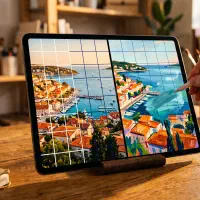
Overgrid puts a customizable grid on any reference photo. Set the rows and columns, adjust line weight, color, and opacity, crop to match your canvas proportions, and the grid appears instantly. Adaptive contrast picks a grid color that stays visible on any background. A value study reduces the reference to tonal levels so you can plan light and shadow before you commit paint. The grid handles placement. Everything else is yours.
Overgrid is available on iOS and Android. Free to use. One-time purchase for everything.