Chuck Close painted faces nine feet tall by dividing them into grids and filling each square one at a time. He worked from photographs, transferred through a precise grid system, and built his monumental portraits square by square across canvases that stood taller than most rooms. His process turned portraiture into a problem of manageable units, and it produced some of the most recognizable paintings of the late 20th century.
The conditions that shaped the work
Close was born in Monroe, Washington, in 1940. He grew up with dyslexia, a neuromuscular condition that limited his mobility, and prosopagnosia, the inability to recognize faces. He struggled in school. Art was the exception.
The prosopagnosia is the detail that matters most for understanding his work. Close could not recognize people by their faces. He could sit across from a friend at dinner and not know who they were until they spoke. This is not forgetfulness. It is a neurological condition where the brain cannot process facial features as a unified identity.
Close turned this deficit into a subject. “People’s faces have urgency for me,” he said. “I don’t care about anything as much as knowing who people are.” Painting portraits was his way of committing faces to memory by slowing the process down, breaking each face into many small, memorable pieces.
He did not set out to become a portrait painter because of his face blindness. He realized the connection later. But the fit between condition and method was precise: the grid let him process a face the way his brain could not, piece by piece, without needing to grasp the whole.
Yale and the rejection of Abstract Expressionism
Close studied at the University of Washington, then earned his BFA and MFA at Yale in the early 1960s. At Yale, he worked in the mode of Abstract Expressionism, emulating Arshile Gorky and Willem de Kooning. He considered himself a third-wave Abstract Expressionist.
Then he stopped. While teaching at the University of Massachusetts from 1965 to 1967, he deliberately put distance between himself and everything he had been doing. He said he “flipped 180 degrees” and began working from photographs.
This turn was not purely a reaction against abstraction. It was aligned with the ideas coming out of Minimalism and Conceptual art. Artists like Sol LeWitt, Richard Serra, and Ad Reinhardt were building work from self-imposed rules, repetition, and process. Close shared these concerns. His grid was not just a transfer tool. It was a system of constraints that generated the painting, the way a LeWitt wall drawing generates itself from a set of written instructions.
Close resisted the photorealist label throughout his career. His interest was process, not illusion.
Big Self-Portrait: half a teaspoon of paint
In 1967, Close took a series of black-and-white photographs of himself. He selected one, a frontal close-up with a cigarette jutting from the corner of his mouth. He drew a grid over the photograph, then transferred the grid onto a canvas measuring 107.5 by 83.5 inches, nearly nine feet tall.
The painting was executed with about half a teaspoon of black acrylic paint, thinned to the consistency of dirty water. Close applied it with brushes and an airbrush. He scraped with razor blades to create sharp areas of definition and rubbed with an eraser attached to an electric drill for the softer tonal blends. One tube of black paint produced seven more portrait paintings after this one.
The result shows every pore, every strand of hair, every capillary in the whites of the eyes. It is painted at roughly fifty times life size. The viewer stands in front of a face that is overwhelmingly, almost uncomfortably present.
Big Self-Portrait was first exhibited publicly on April 17, 1970, and was acquired by the Walker Art Center. It established Close’s method and his subject: the human face, at monumental scale, built from a grid.
The CMYK paintings: color as process
After the black-and-white portraits, Close moved to color. But he did not simply switch to a full palette. He developed a method that mimicked the mechanical color separation used in commercial printing.
Close painted in three passes: cyan, magenta, and yellow, layered on top of each other. The first portrait executed this way was Kent (1970-71), which took nearly a year to complete. Close expected that painting the same image three times would take three times as long. It did.
To see each color layer independently, he wore tinted cellophane filters over his eyeglasses. Each pass was painted from the gridded photograph, square by square, in a single color. When the three layers combined, the viewer’s eye mixed them into a full-color image, the same principle used in four-color printing.
This was not a shortcut. It was a more complex version of the same systematic approach. Close was interested in how a face could be built from a process, not from intuition.
Fingerprints, paper pulp, and everything else
Close never stopped experimenting with how to fill the grid.
In the late 1970s, he began using his own fingerprints as the mark-making unit. In works like Fanny/Fingerpainting (1985), he inked his fingers and pressed them onto the canvas within the grid, varying density to create tone and modeling. Each print was both a standardized unit, repeatable and countable, and an irreducibly personal mark. The fingerprint series was a conceptual stroke: the most common form of identification used as an artistic building block by someone who could not recognize faces.
He worked in paper pulp, squeezing tinted pulp through stencils and matrices. He made mezzotints, a printmaking technique abandoned in the 18th century, and found that the process revealed grid-like patterns he could exploit. He made Jacquard tapestries woven with more than 17,800 threads. He made daguerreotypes in collaboration with Jerry Spagnoli, adapting a photographic process from the 1840s into large-format portraits with hyperdetailed, reflective surfaces.
The medium changed constantly. The grid did not. Every one of these experiments was built on the same framework: divide the image into cells, fill each cell according to rules, and let the accumulation of individual decisions create a whole that none of the parts could predict.
December 7, 1988
On December 7, 1988, Close was rushed to the hospital with what he described as excruciating chest pain. He was diagnosed with an occlusion of the anterior spinal artery. Almost immediately, he was paralyzed from the neck down.
The diagnosis was incomplete quadriparesis. He was expected to have only limited movement in all four limbs for the rest of his life. In the hospital, when he could move only his head, he told a friend he would work with a brush clenched in his teeth. He would spit paint on the canvas if he had to.
Through rehabilitation, Close regained some movement in his arms, more in the biceps than in the forearms. He learned to walk short distances with crutches. He painted from a wheelchair for the rest of his career, using a brush strapped to his wrist with a device that held it in position.
His studio was rebuilt around his condition. A motorized easel, controlled by foot pedals, raised and lowered his large canvases through a slit in the floor, keeping whatever section he was working on at arm’s reach. The canvases still measured nine feet. The grid still started at the top left. The squares were still filled one at a time, working across and down.
Close later said: “I don’t think it’s affected my art all that much.” This is both true and not true. The method survived intact. What changed was the nature of the marks inside each square.
The late paintings: abstraction made visible
Before 1988, Close’s grid was a means to an end. The lines disappeared into the finished surface. After 1988, the grid became the surface.
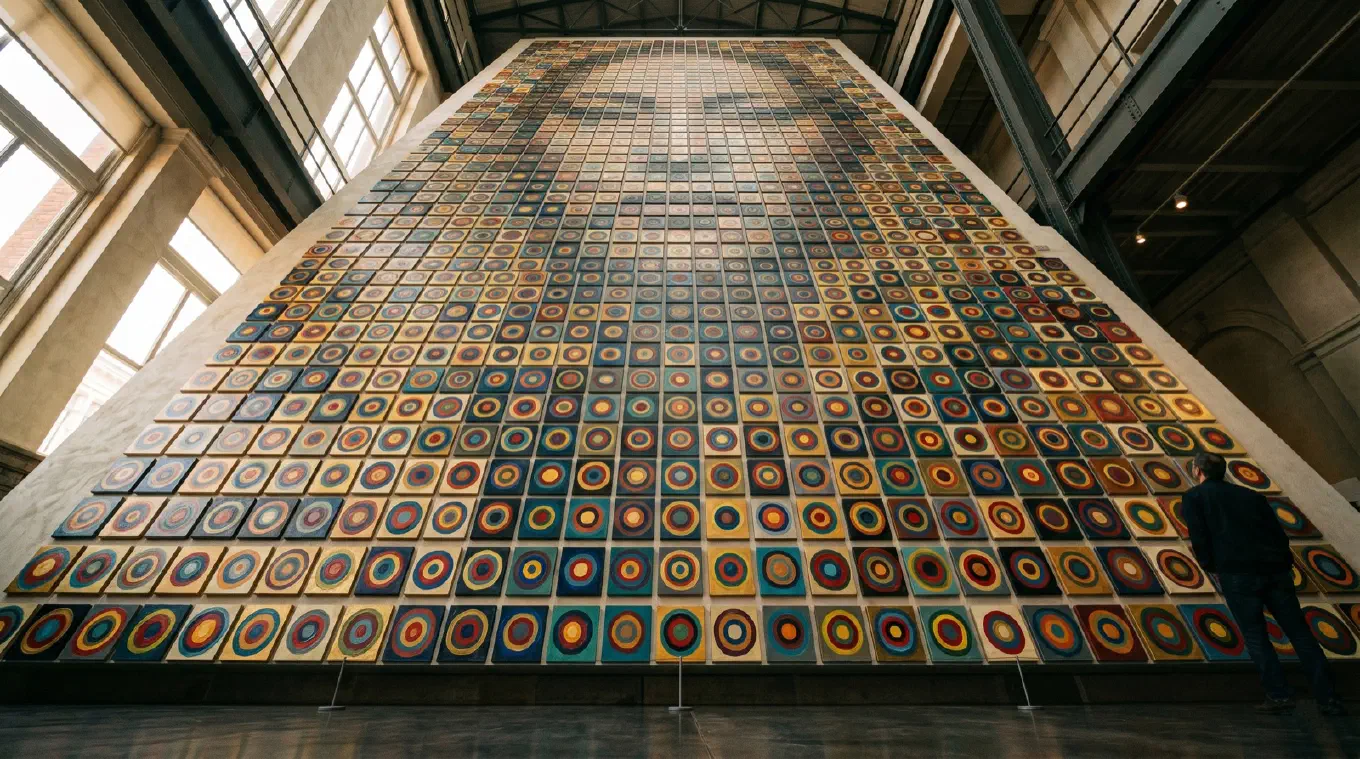
His later paintings replaced the minute, continuous-tone detail of the early work with a visible grid of tiles. Each tile contained shapes, typically concentric rings or elliptical forms, painted in bright, sometimes clashing colors on a contrasting background. Up close, each tile is an abstract painting in miniature. From across the room, the tiles resolve into a face.
This was not a diminished version of the earlier work. It was an evolution that made the underlying logic visible. The early paintings concealed the process behind photographic smoothness. The later paintings revealed it. You could see exactly how the face was built, one unit at a time, and you could watch the transition from abstract marks to recognizable portrait happen in real time as you walked backward.
Close described each grid cell as an arena for decision-making. The system provided constraints, the grid, the palette, the rules of the game, and within those constraints, every cell was an improvisation. This is the same paradox that made his career: a systematic, rule-bound process that generated the unexpected.
What the grid taught him
Close’s most quoted line is: “Inspiration is for amateurs. The rest of us just show up and get to work.” He said it in a 2006 interview with Joe Fig, published in Inside the Painter’s Studio (2009).
The statement is not bravado. It is a description of his method. Close did not wait for vision to strike. He sat down, found the next empty square, and filled it. The decisions accumulated. The painting emerged.
He compared his process to knitting or quilting: “I slowly build these paintings, construct them the way somebody might make a quilt or crochet or knit.” He said he broke everything down “into bite-size pieces, into lots of little manageable decisions.”
This is what the grid method teaches, whether you are painting a nine-foot face or transferring a reference photo to a 16x20 canvas. The whole is overwhelming. Any single square is not. Focus on the shapes within one square, ignore the rest, and the accumulation of small, correct decisions creates something that no amount of staring at the big picture could produce.
Close proved this at the most extreme scale possible. If the method works at 107.5 by 83.5 inches, it works at any size.
The grid today
Close’s grid was a pencil line on a photograph and a corresponding pencil line on a canvas. The photographs were large-format Polaroids or prints. The grid had to be drawn by hand, measured, numbered. Changing the grid density meant starting over.
The principle is the same today. The materials have changed.
Overgrid places a customizable grid on any reference photo. Set the rows and columns, adjust line weight and color, crop the image to match your canvas proportions, and the grid appears instantly. Change it as often as you want. No ruler marks, no starting over. Adaptive contrast picks a grid color that stays visible against any background, the kind of small practical problem that Close solved by squinting and choosing. A value study reduces the reference to tonal levels so you can plan light and shadow before committing paint, the way Close planned his work through the photograph before touching the canvas.
The grid method is 3,500 years old. Van Gogh built a grid frame in 1882. Close made it the structural principle of a fifty-year career. The tool changes. The method holds.
Overgrid is available on iOS and Android. Free to use. One-time purchase for everything.