Muddy shadows happen when temperature, chroma, or value goes wrong in the dark side of a painting. The fix is one of three things: separate the temperature between light and shadow, stop mixing complementary pigments that kill chroma, or simplify the values in your shadow range. Here is how to diagnose which problem you have and fix it.
What “mud” actually is
Mud is not a color. It is a relationship problem.
When painters say a shadow looks muddy, they mean it looks dull, lifeless, and disconnected from the light. The shadow does not read as shadow. It reads as dirty paint. The surface looks overworked, the form flattens, and the viewer’s eye slides past without registering depth or atmosphere.
In color theory terms, mud is the unintentional loss of chroma. Chroma is the intensity or saturation of a color, separate from its hue and value. A shadow needs to be darker than the light (lower value), and it may shift in hue, but it should still carry some chromatic life. When chroma drops to near zero accidentally, you get mud.
The key word is accidentally. Low-chroma colors are not inherently bad. Earth tones, grays, neutrals are essential in painting. The problem is when chroma dies in places where it should be alive, specifically in your shadows, where the viewer expects to see color that has been dimmed, not killed.
Cause 1: Temperature contamination
This is the most common cause of muddy shadows, and the hardest to see while you are painting.
The principle is simple: warm light produces cool shadows. Cool light produces warm shadows. This is not an aesthetic preference. It is physics. When sunlight (warm, yellow-orange) hits a form, the lit side reflects that warmth. The shadow side, blocked from the direct warm source, is illuminated by the sky (cool, blue-violet). The shadow picks up the sky’s temperature.
The reverse applies under cool light. An overcast sky or north-facing window casts cool illumination, and the shadows, receiving less of that cool light, appear comparatively warmer.
Mud happens when you ignore this relationship. If the light is warm and you paint your shadows warm too, there is no temperature shift. The painting goes flat. The shadow does not read as absence of direct light. It reads as the same light, just darker. Your brain cannot parse the spatial information, and the result feels wrong. That wrongness is what painters call mud.
How Sorolla kept shadows luminous
Joaquín Sorolla painted Mediterranean beach scenes under intense warm sunlight. His shadows are the opposite of muddy. They glow. Look at Walk on the Beach (1909) or Children on the Beach (1910), and the shadows on the sand and skin are distinctly violet-blue, pushed deliberately toward cool to create maximum contrast against the warm light.
Sorolla did not simply darken local colors for his shadows. He shifted them toward blue and violet further than they actually appeared. He pushed his lights toward yellow more than they were. This exaggeration of the temperature gap is what creates the sensation of blinding Mediterranean sun. His palette included cobalt violet, manganese violet, cobalt blue, and French ultramarine, all tools specifically for building cool shadow color. He avoided black in shadows entirely, preferring to construct his darks from complementary tones: deep blues against warm oranges, violets against yellows.
EDXRF analysis of his Visions of Spain paintings, published by Roldan et al. in X-Ray Spectrometry (2011), identified up to 29 inorganic pigments, confirming that Sorolla used manganese violet as his primary violet pigment and cobalt aluminate blue as his primary blue. These are the pigments doing the work in those luminous shadows.
How Sargent managed temperature in portraits
John Singer Sargent took a different approach to the same principle. In portraits like Lady Agnew of Lochnaw (1892), the shadow side of the face is painted with a thick mixture of cadmium orange, ultramarine blue, and a small amount of the base flesh tone. This sounds like a recipe for mud, two near-complements mixed together. But Sargent controlled the ratio precisely.
The orange gives warmth to the reflected light within the shadow. The ultramarine provides the overall cool lean. The mixture stays chromatic because neither component overwhelms the other. As a whole, Sargent’s shadows read cooler than his lights, but within the shadow, he introduced subtle temperature variation: slightly warmer passages for reflected light, slightly cooler passages in the deepest shadow. This internal temperature play gives his shadows their sense of atmosphere and transparency.
Sargent also used temperature at the edges. He placed a warm red edge on the light side of the face, running along the terminator where light meets shadow, and a cool blue edge on the shadow side running along the reflected light. These edge temperatures heighten the viewer’s perception of form turning away from the light.
Cause 2: Chroma death from accidental complement mixing
Every time you mix two pigments that sit across the color wheel from each other, you move toward neutral. This is subtractive mixing. Pigments work by absorbing wavelengths of light. When you combine two complementary pigments, each one absorbs what the other reflects. The result is a mixture that reflects very little saturated light. Gray. Brown. Mud.
This is not a problem when you do it on purpose. Intentional complement mixing produces beautiful neutrals, warm grays, chromatic darks, earthy tones that hold a painting together. The problem is when it happens without your knowledge.
The most common accident: you reach for a blue to darken a warm color. The blue and the warm pigment are near-complements. The mixture goes gray. You add more pigment to fix it, which only pushes it further toward neutral. The shadow is now dead.
Another common accident: mixing three or more pigments that collectively span the color wheel. Any mixture that effectively combines all three primaries (red, yellow, blue) will tend toward a dull gray-brown. Two pigments that contain traces of the third primary can produce the same effect. This is why some reds mixed with some greens produce brown, not because of a specific rule, but because the mixture covers too much of the spectrum.
The Munsell explanation
The Munsell color system separates color into three independent dimensions: hue, value, and chroma. In Munsell space, chroma radiates outward from a neutral gray center axis. High-chroma colors sit at the perimeter. Low-chroma colors sit near the center.
When you mix complements, you move the mixture toward the center of the Munsell space. Chroma drops. Paul Centore, in his research on shadow series in the Munsell system, showed that when a color enters shadow (decreases in value), its chroma should decrease proportionally. The rate is roughly linear: if value drops by 30%, chroma should drop by about 30%. This maintains the appearance of the same color, just dimmer.
The problem with accidental complement mixing is that it drops chroma faster than value. You end up with a mixture that is both dark and dead, lower in chroma than it should be for its value. The Munsell proportional relationship is broken, and the color looks wrong. It looks like mud.
How a limited palette prevents this
A limited palette like the Zorn palette avoids this problem structurally. With yellow ochre, vermilion, ivory black, and white, there are no high-chroma complementary pairs to collide. Ivory black leans cool but is already low in chroma. You cannot accidentally neutralize your colors because the palette does not contain the weapons for it.
This is the deeper reason limited palettes produce clean color. It is not just discipline or tradition. It is chemistry. Fewer pigments mean fewer absorption spectra interacting, which means less accidental chroma destruction.
Cause 3: Value compression
The third cause of mud is putting too many values into the shadow range.
In classical atelier training, painters learn to divide their subject into two families: the light family and the shadow family. Everything receiving direct light belongs to one group. Everything in shadow belongs to the other. The critical discipline is maintaining clear separation between these two families. The darkest value in the light family should be distinctly lighter than the lightest value in the shadow family.
Problems start when you try to render the same level of form modeling in the shadows that you use in the lights. In the lit areas, you might use five or six value steps to describe the gradual turn of a form. If you try to use the same number of steps in the shadows, those values compress into a narrow band between, say, Munsell value 2 and value 4. The human eye cannot distinguish small value steps in the dark range as well as it can in the light range. The result is a shadow full of barely distinguishable value shifts that read as a single confused, overworked mess. Mud.
Sargent understood this. His shadows are broad, simplified planes. Look at his unfinished portraits and you can see it clearly: the light side of the face is modeled with multiple value steps, but the shadow side is one or two values at most. He maintained the separation between light and shadow by refusing to over-model the dark side. The shadow reads as shadow precisely because it is simple.
Sorolla did the same with outdoor light. He painted his shadows at a mid-gray value or darker, which gave him room at the lighter end of the scale to push highlights and convey the impression of bright sunlight. His value structure was planned before the color went down.
How to diagnose your mud
When a shadow looks wrong, check three things in this order:
1. Temperature. Step back and squint. Is there a clear temperature shift between the light side and the shadow side? If both feel warm, or both feel cool, the temperature relationship is broken. The fix is to push the shadow temperature in the opposite direction from the light. If the light is warm, cool the shadows down. This does not mean adding blue paint everywhere. It means ensuring that the overall lean of the shadow mixture is cooler relative to the light.
2. Chroma. Look at the shadow mixture on your palette. Is it a clean, identifiable color that has simply been darkened? Or has it gone gray and lifeless? If the latter, you have likely mixed across the color wheel. Scrape it off. Start with fewer pigments. Mix your shadow color from adjacent colors on the wheel, not from opposing ones. A blue shadow darkened with a touch of its neighbor (blue-violet or blue-green) stays chromatic. A blue shadow darkened by mixing with orange dies.
3. Values. Squint hard. Can you count the number of distinct value steps in your shadow? If you can see more than two or three, you are probably compressing. Simplify. Merge the close values into one decisive tone. The shadow should be a single mass with, at most, one accent of reflected light. Reserve your value detail for the lights.
How Undertone reveals the problem
Undertone makes these three diagnostics visible on any image.
The temperature map overlays a per-pixel warm-cool analysis on your painting or reference. Where warm pigment has leaked into a shadow that should be cool, the map shows it immediately. You can see exactly where the temperature contamination is happening, something that is difficult to judge by eye alone because the brain compensates for color relationships.
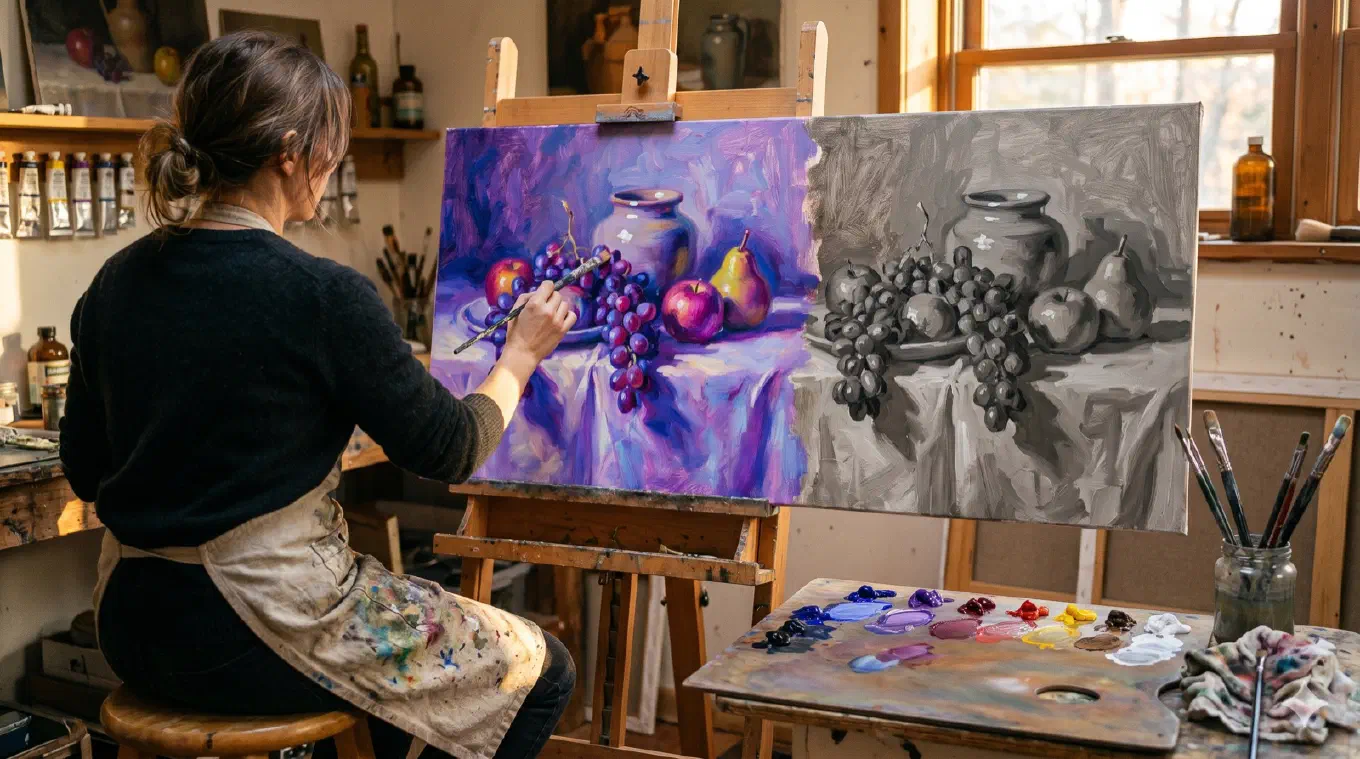
The value structure strips color and divides the image into light, mid-tone, and dark zones. If your shadows contain too many value steps, the posterized view makes it obvious. You can see where values are compressed and where they need simplification.
Point Undertone at the painting you admire and the painting you are struggling with. Compare the temperature maps. Compare the value structures. The gap between them is almost always specific and diagnosable. Not “the mood is wrong.” Instead: “the shadow temperature matches the light, and the shadow values are compressed into five steps instead of two.”
That specificity is what turns a frustrating problem into a solvable one.
The fix, summarized
Clean shadows come from three decisions:
Separate the temperature. Warm light, cool shadows. Cool light, warm shadows. Exaggerate the shift slightly, the way Sorolla did. The viewer’s eye reads temperature contrast as light and air.
Protect the chroma. Mix shadows from adjacent colors on the wheel, not from opposites. Use fewer pigments per mixture. If you need a dark, reach for a transparent dark pigment rather than mixing your way across the color wheel to get there.
Simplify the values. Shadows are one or two values. Not five. The light family carries the modeling. The shadow family carries the atmosphere. Keep them separate, and the painting reads.
Every master who painted luminous shadows, from Sorolla’s Mediterranean beaches to Sargent’s drawing-room portraits to Zorn’s four-color portraits, arrived at these same three principles. Temperature, chroma, value. Fix the one that is broken, and the mud clears.
Undertone analyzes any painting or photograph across multiple dimensions: palette, harmony, temperature, value structure, composition, saturation, and contrast. All on-device. Available for iOS, Android, and macOS.