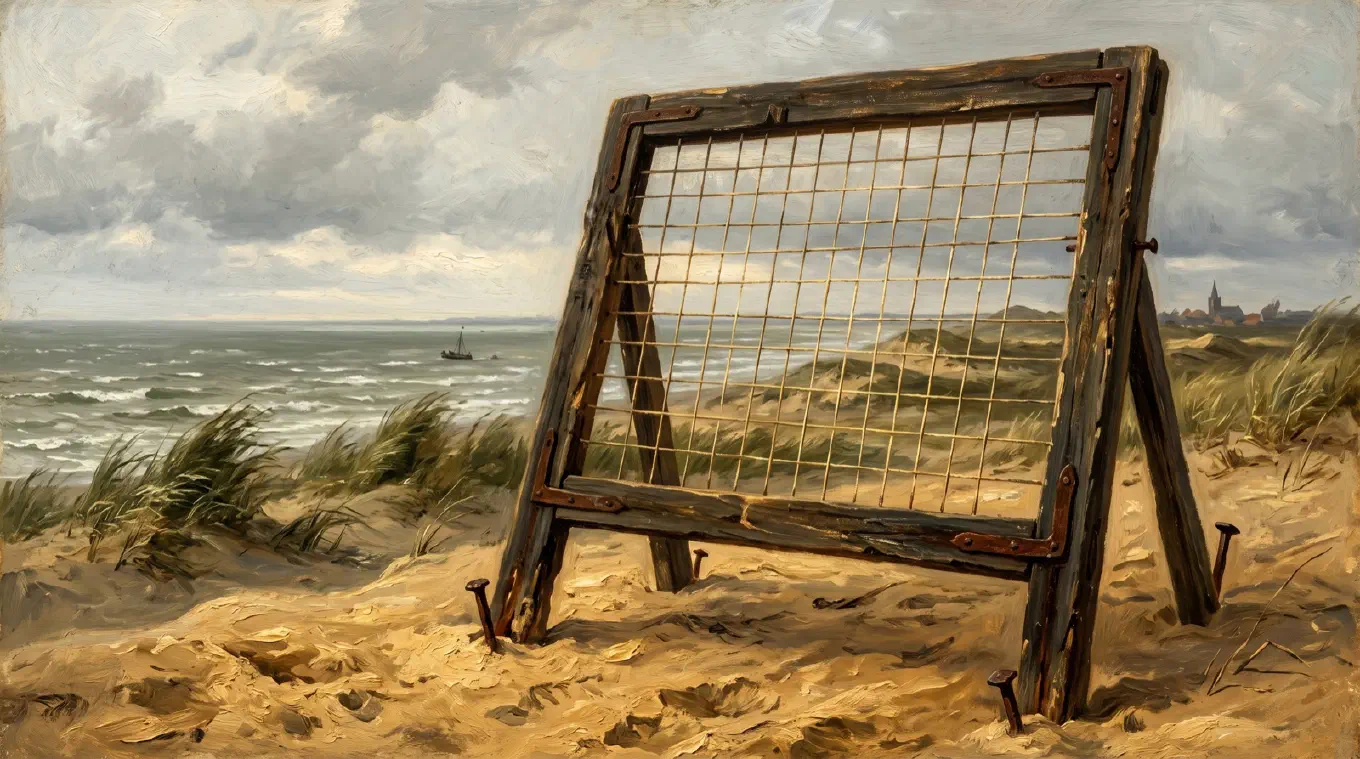
Van Gogh built his own grid frame in August 1882. He had a blacksmith in The Hague fit it with iron spikes so he could plant it in the sand dunes, and he used it to draw beach scenes, meadows, and city views at speed. The design came from Albrecht Dürer’s 1525 woodcut, which Van Gogh found in a drawing manual by Armand Cassagne. The most emotionally raw painter in history used a grid because technique enables expression, not the other way around.
The frame
In early August 1882, Van Gogh wrote two letters to his brother Theo about a perspective frame he was having built. The device was simple: a wooden frame strung with threads forming a grid, mounted on two long legs with iron spikes at the base for stability on uneven ground. He had just come back from the blacksmith, who put iron spikes on the legs and iron corners on the frame.
The frame could be positioned horizontally or vertically using strong wooden pegs. Van Gogh described the effect: “on the beach or in a meadow or a field you have a view as if through a window.” The perpendicular and horizontal lines, together with the diagonals and the cross, provided a clear guide to the principal features of the scene.
He called it “a delightful thing” and was specific about what it gave him: “With considerable practice and with lengthy practice, it enables one to draw at lightning speed and, once the lines are fixed, to paint at lightning speed.”
Van Gogh was not naive about the tool. He stated its limitation clearly: “Without this the instrument is of little or no use at all, and it makes one dizzy to look through it.” You needed to understand perspective first. The frame did not teach you to see. It accelerated what you already knew.
The lineage
Van Gogh did not invent this tool. He built one from a diagram he found in Armand Cassagne’s Guide de l’alphabet du dessin (1880), a drawing manual popular in France and the Netherlands at the time. Cassagne’s diagram referenced Albrecht Dürer’s perspective devices from 1525.
The lineage runs deeper still.
Leon Battista Alberti (1435) described a “velo” in De Pictura, the first theoretical text on painting in Europe. It was a thin veil divided into squares, stretched inside a frame, placed between the artist and the subject. The grid broke the visual field into cells that could be transferred one at a time onto paper. This was the idea in its earliest documented form.
Albrecht Dürer (1525) published illustrated instructions for building perspective devices in Underweysung der Messung. His woodcuts showed the artist looking through a gridded frame at a subject, drawing what appeared in each cell onto a corresponding grid on paper. These images became the standard reference across Europe. A 2024 experimental reconstruction of all four Dürer devices, published in Early Science and Medicine, confirmed that the two complex machines were inaccurate, time-consuming, and almost unworkable. The simple grid frame proved faster and more reliable for actual drawing.
Van Gogh (1882) saw Dürer’s design in Cassagne’s manual and had one built. Three and a half centuries after Dürer published the instructions, the grid frame was still the fastest, most reliable tool for drawing accurately from observation.
The principle has not changed. Only the materials have.
Why this matters
There is a persistent myth that great artists work from pure feeling. That tools are a crutch. That relying on a grid means you cannot really draw.
Van Gogh destroys this argument. He is the painter people cite when they want to talk about raw emotion in art, about painting from the gut, about breaking rules. And he built a grid frame. He used it regularly. He wrote about it with obvious enthusiasm.
The reason is simple. Proportion is a solved problem. Knowing where the horizon sits, where the roofline ends, where the figure’s shoulder falls relative to the edge of the canvas, these are questions with correct answers. Getting them wrong does not make a painting more expressive. It makes it wrong.
Van Gogh wanted to spend his attention on color. On the weight of a brushstroke. On the emotional temperature of a scene. The grid frame freed him to do that by handling the mechanical problem of placement. He said it himself: the frame enabled him to paint at lightning speed. Not just draw. Paint.
Accuracy is not the enemy of expression. It is the foundation.
The grid today
The principle behind Van Gogh’s frame is the same one behind every grid overlay app on your phone. Divide the reference into cells. Match those cells on your canvas. Transfer one square at a time. The wood and iron are gone, replaced by software, but the geometry is identical.
Overgrid does what Van Gogh’s frame did: it places a grid over your reference image so you can transfer proportions accurately to your canvas. Adjustable rows and columns, line weight, opacity, and color. No blacksmith required. No iron spikes. Just the same 500-year-old method, available in seconds on any photo.
Van Gogh needed a frame to draw the dunes at Scheveningen. You probably need one for the portrait commission on your easel, or the landscape you photographed last weekend, or the still life you are scaling up to a larger canvas. The problem has not changed. The tool has gotten lighter.