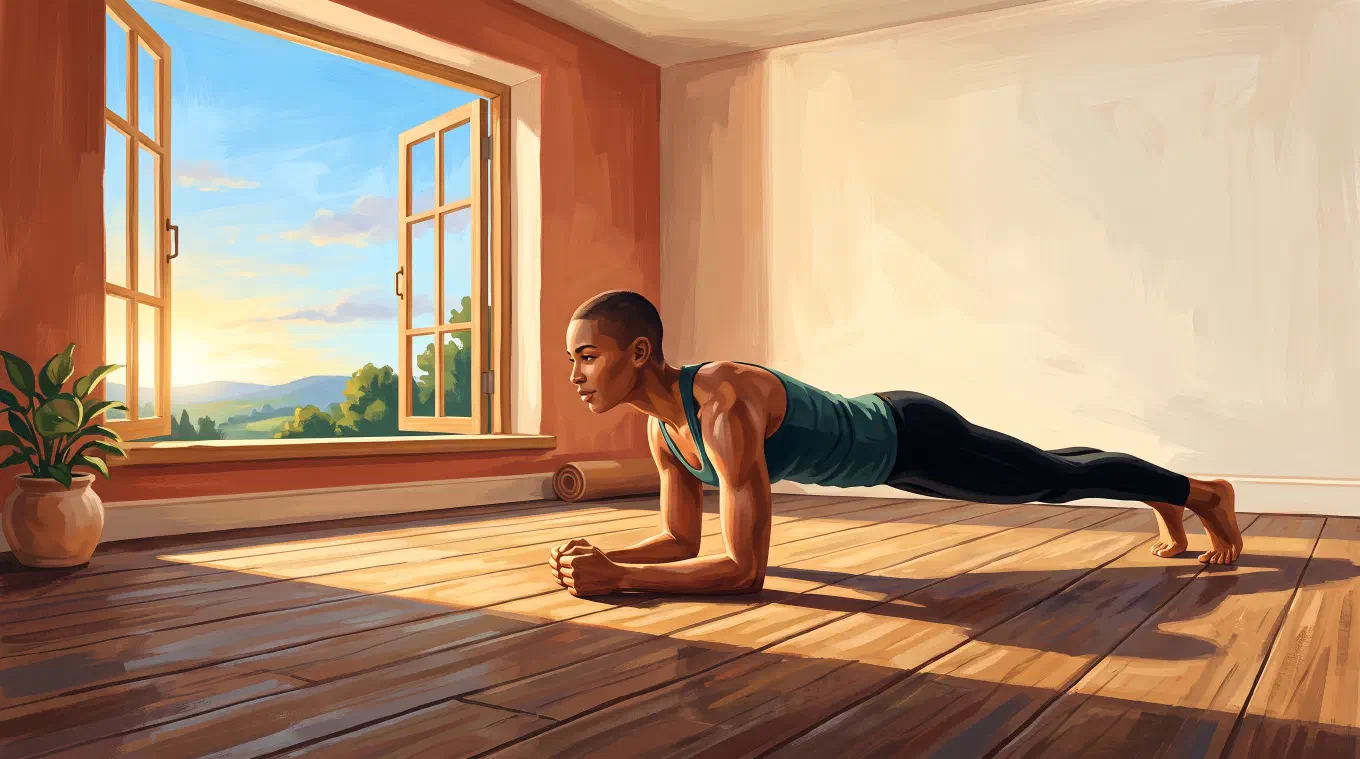
Most people should hold a plank between 30 and 120 seconds per set, stopping the moment form breaks. In the largest norms study, college men held an average of 124 seconds and women 83. Beyond two minutes there is little extra benefit. Make the plank harder, not longer.
That is the short answer. The longer answer is more interesting, because “how long” turns out to be only half the right question. Here are the numbers you came for, and then the model that makes them useful.
The average plank time, measured
The best data on how long people actually hold a plank comes from a 2014 study in the Journal of Human Kinetics, “Norms for an Isometric Muscle Endurance Test” by Strand and colleagues. They had 471 college students, 194 men and 277 women including 109 varsity athletes, hold a forearm plank to failure. The test ended when the person gave up, lost the position, reported ill effects, or could not correct their form.
The results. Men held an average of 124 seconds, with a median of 110. Women held an average of 83 seconds, with a median of 72. The standard deviations were enormous, 72 seconds for men and 63 for women, which tells you plank times vary wildly even among healthy 20-year-olds. Someone holding 50 seconds and someone holding 3 minutes can both be normal.
So if you can hold a clean forearm plank for 60 to 90 seconds, you are in respectable company. If you can hold two minutes, you are above the average of a population that included varsity athletes.
The two-minute standard
Strength coach Dan John draws the line exactly there. His widely cited benchmark: a fit, healthy person should manage a two-minute plank, and past two minutes there is nothing left to gain. His words: “Enough is enough. It’s just a plank. More is not better.”
Treat two minutes as a graduation requirement, not a career. Getting from one minute to two is real work and worth doing. Getting from two minutes to five is mostly a demonstration that you can tolerate being uncomfortable, which is a skill, but not the one you started planking for.
Why repeated short holds beat one long hold
Stuart McGill, professor emeritus at the University of Waterloo who spent three decades researching spine biomechanics, goes further than Dan John. For the average person he recommends repeated holds of 10 seconds rather than one long grind. For spine health specifically, he prescribes his Big 3: the modified curl-up, the side plank, and the bird dog.
The logic is about quality. The plank’s job is to train your core to brace hard, and a maximal brace cannot be held long. In the first seconds of a hold, everything fires: abs, glutes, lats, quads. As the seconds pass, that tension quietly drains away and the position is maintained by less and less muscular effort. A five-minute plank is not five minutes of core training. It is thirty good seconds followed by a long, slow sag.
Short repeated holds flip that ratio. Ten hard seconds, rest, ten hard seconds again. Every second is a quality second, and across sets you bank more full-tension work than a single long hold ever contains. If that structure sounds familiar, it is the same principle behind greasing the groove: frequent, fresh, submaximal practice beats occasional exhaustion.
The world record proves the point
The Guinness World Record for the longest abdominal plank by a male belongs to Josef Šálek of the Czech Republic: 9 hours 38 minutes 47 seconds, set in Pilsen on 20 May 2023.
Nine and a half hours. Whatever kept Josef Šálek in that position, it was not the strength of his abs, because no muscle contracts hard for nine hours. It was extraordinary preparation, pacing, and pain tolerance. Which is precisely McGill’s point about marathon planks: “There’s no utility to this kind of activity other than claiming a record.” The record is genuinely impressive. It is also the clearest evidence that plank duration, past a point, stops measuring what you think it measures.
What to do once two minutes is easy
Make the plank harder, not longer. A harder plank drops you back to short holds and full tension, which is where the training effect lives. Three proven upgrades:
- Squeeze everything. The hard-style plank: contract your abs, glutes, and quads as hard as you can for the whole hold. Done honestly, 15 to 20 seconds is brutal, and a comfortable one-minute hold becomes impossible.
- Lengthen the lever. Walk your elbows a few centimeters forward of your shoulders. The load on your abs jumps sharply with every centimeter.
- Remove a support. Lift one foot, then one arm. The plank becomes an anti-rotation exercise, which is closer to what your core does in real life.
Full form cues, common mistakes, and easier regressions for the plank live in our guide to the six bodyweight exercises.
The quiet bonus: blood pressure
There is one plank benefit that has nothing to do with abs. A 2023 meta-analysis in the British Journal of Sports Medicine, covering 270 trials and roughly 16,000 participants, found that isometric exercise, the static-hold category that includes wall sits and planks, was the most effective exercise mode for lowering resting blood pressure. Isometric training reduced blood pressure by about 8.24/4 mmHg, versus 4.49/2.53 mmHg for aerobic exercise.
Two cautions. Breathe the entire time you plank, because holding your breath during a static contraction spikes blood pressure in the moment. And if you already have high blood pressure or a heart condition, talk to a doctor before adding isometric training.
Time your holds, or you are guessing
Everything above depends on knowing your number. You cannot compare yourself to the norms, chase the two-minute bar, or verify that hard-style holds really are shorter unless you time your holds and write them down. Untimed planks all feel the same. Timed planks show a line going up, and the record itself is what keeps you coming back.
This is what Kountrain is for. Planks are one of its six built-in exercises and the only one logged in seconds rather than reps, with a built-in timer screen for the hold and a form guide in your pocket. Set a daily seconds goal, log each hold, and watch streaks, records, and totals accumulate. It works offline, needs no account, and the core is free with no subscription. Your data stays on your device.
Kountrain is available on the App Store and Google Play.