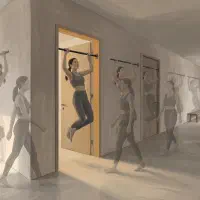
You need 4.4 minutes per day. Not 30. Not 60. A 2022 study in Nature Medicine tracked 25,241 non-exercisers and found that three bouts of one to two minutes of vigorous movement per day reduced all-cause mortality by 26 to 30 percent. Exercise snacking is the method that fits those minutes into a life that has no scheduled time for fitness.
What the science says
The VILPA study (Stamatakis et al., Nature Medicine, 2022) used wrist-worn accelerometers to track vigorous intermittent lifestyle physical activity in UK Biobank participants over 6.9 years. The subjects were people who reported no leisure-time exercise. They were not athletes. They were not gym members. They were sedentary adults.
The findings were specific. Three bouts per day lasting one to two minutes each produced a 38 to 40 percent reduction in all-cause mortality and a 48 to 49 percent reduction in cardiovascular mortality. The median duration was 4.4 minutes per day total. The effect was comparable to what structured exercisers achieved.
Adherence is the other half of the equation. A systematic review in the British Journal of Sports Medicine found that exercise snacking programs achieved 91% compliance, compared to roughly 50% for traditional exercise programs. The reason is simple. Short bouts don’t require willpower, planning, or childcare. They happen inside the life you already have.
What exercise snacking looks like for a parent
The barrier for parents is not motivation. It’s logistics. A BMC Public Health study found that family responsibilities and guilt are the primary obstacles to physical activity for working mothers and fathers. You know you should move. You feel guilty taking time away from your kids to do it. Exercise snacking dissolves that conflict because it doesn’t take time from anything.
Here are trigger moments that already exist in your day:
- While the kettle boils. 90 seconds. 15 squats.
- During screen time. Your child watches something. You do push-ups next to the couch.
- While the bath fills. Lunges in the hallway. Two minutes, done.
- First two minutes of nap time. Before you reach for your phone.
- While food heats in the microwave. 60 seconds of bodyweight squats.
- At school drop-off. Walk back to the car fast. Genuinely fast.
- While they eat in the high chair. Planks on the kitchen floor.
None of these require changing clothes, driving somewhere, or asking someone to watch your children. They require noticing a gap and filling it.
The compound math
Small numbers lie. They feel like nothing. But they accumulate.
A realistic day: 15 squats while the kettle boils. 10 push-ups during screen time. 20 squats before lunch. 10 lunges while the bath fills. 15 push-ups at nap time.
That’s 70 reps. From “nothing.”
70 reps per day is 25,550 reps per year. That’s not nothing. That’s a training volume most gym members don’t reach for bodyweight exercises. The difference is visibility. A gym session feels like something. Seventy scattered reps feel like nothing unless you count them.
Greasing the groove
Pavel Tsatsouline formalized this principle decades ago as “greasing the groove.” The idea: strength is a skill. Skills improve through frequent, submaximal practice. Do 50% of your maximum reps, many times per day, and your nervous system adapts. Not through muscle breakdown. Through neural efficiency.
People have gone from 5 pull-ups to 15 in a month using this method. Not by training harder. By training more often at lower intensity. The nervous system learns to recruit muscle fibers more efficiently when you practice a movement frequently without fatigue.
For parents, greasing the groove is not a training philosophy. It’s a description of what your day already allows. You cannot do a 45-minute session. You can do 10 push-ups six times. The total volume is the same. The adaptation is real.
The immediate payoff
The long-term health benefits are compelling, but they don’t get you off the couch at 7 AM after a broken night of sleep. What does: the immediate mood shift.
Exercise produces an acute reduction in perceived stress. Not after weeks of consistency. After 60 seconds of effort. One set of squats changes your neurochemistry measurably. Cortisol drops. Endorphins rise. Your patience with the next tantrum increases by a margin you can feel.
This is the real sell for exhausted parents. Not “you’ll live longer.” That’s abstract. The real sell is “you’ll feel better in 90 seconds, and the feeling lasts an hour.” That’s concrete. That’s today.
Why tracking matters
Exercise snacking has one structural weakness. The sessions are so small that they feel insignificant. You do 10 push-ups and your brain files it under “barely counts.” Without a record, the behavior fades. Not because it stopped working, but because you stopped noticing it working.
Tracking converts invisible effort into visible progress. You see that you did 70 reps today. 490 this week. 2,100 this month. The number grows regardless of whether any single session felt impressive. The accumulation is the point.
Kountrain is built for exactly this pattern. Log a set in five seconds. Push-ups, squats, lunges, planks, pull-ups, burpees. The app tracks your daily total, maintains your streak, and unlocks achievements as you cross milestones. You did 1,000 push-ups this year. You didn’t plan to. It happened 10 at a time.
Daily goals with a progress bar. Streaks that cost something to break. Personal records for your best sessions. Core features free; custom exercises are a one-time Premium purchase. Available on iOS and Android.
The point is not gamification for its own sake. The point is making 4.4 minutes per day feel like what it actually is: enough.