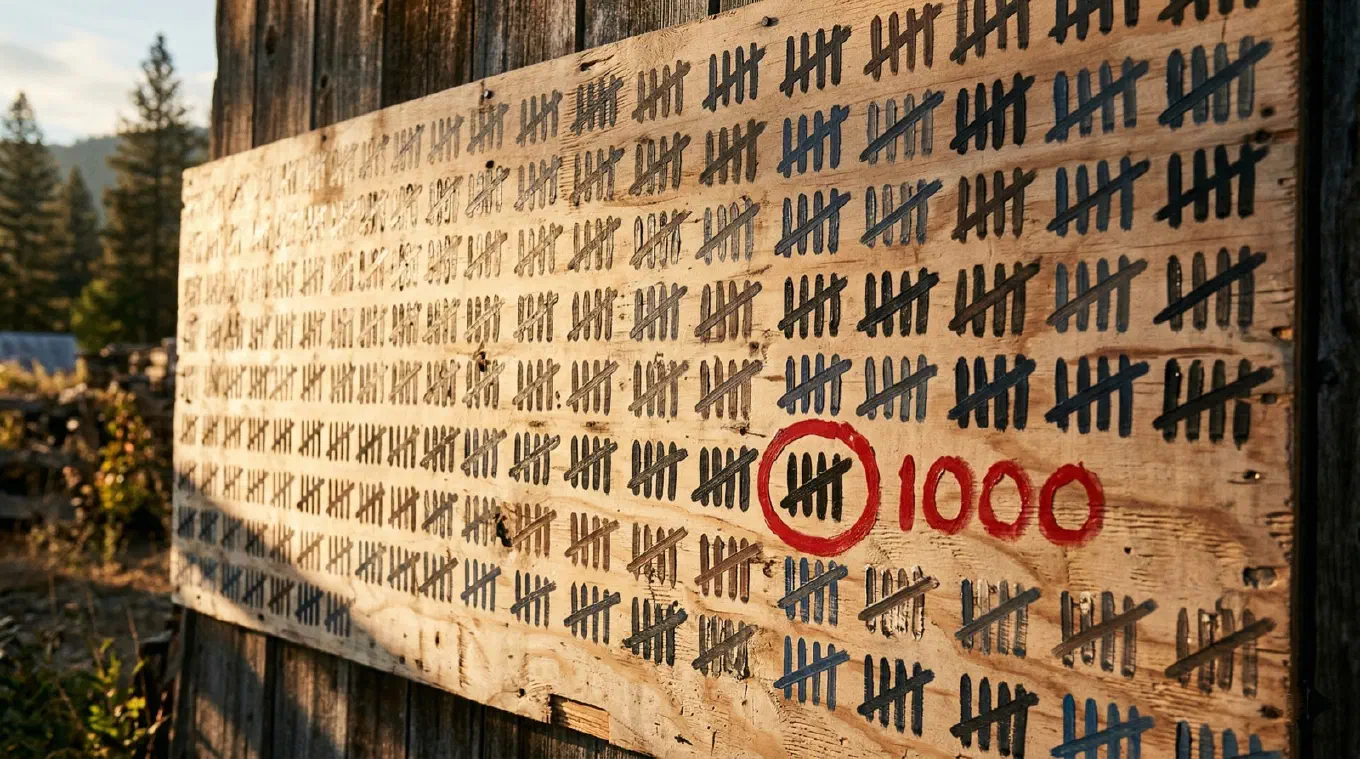
You gamify a home workout by adding a feedback loop. Track every rep. Set a daily goal. Build a streak. Unlock achievements when you hit milestones. The point is not to make exercise entertaining. The point is to make invisible progress visible. Once you can see your consistency, you stop quitting.
The real problem with home workouts
The problem with bodyweight exercises is not the exercises. Everyone knows how to do push-ups. There are thousands of YouTube videos on perfect squat form. The knowledge is free and everywhere.
The problem is invisibility. You do 20 push-ups before a meeting. Ten squats while waiting for coffee. A plank before bed. Nobody sees it. You don’t write it down. By Friday you have no idea what you did on Tuesday. There is no record, no accumulation, no sense that any of it added up.
Gym workouts don’t have this problem. You add plates to the bar. The weight goes up. Progress is literal. But bodyweight reps feel the same at rep 50 as they do at rep 500. Without a feedback loop, the behavior fades. Not because you’re lazy. Because invisible effort is hard to sustain.
What gamification actually means here
Gamification has become a word that means everything and nothing. Some fitness apps add RPG avatars, quests, boss battles, and loot drops. That works for some people. But research points to something counterintuitive: too many game elements can hurt long-term adherence. The novelty wears off, and you’re left with complexity on top of the thing you already weren’t doing.
The gamification that sticks is simpler. It’s the same mechanics that make you close your Apple Watch rings or maintain a GitHub commit streak. Feedback loops. Visible progress. Small wins that compound.
Four mechanics matter.
Streaks
A streak counter is the simplest feedback loop: did I show up today? The power of a streak is not the number. It’s the cost of breaking it. A 14-day streak is worth protecting. That protection becomes motivation that requires zero willpower.
Daily goals
A daily rep target turns an open-ended activity into a finite game. “Do some push-ups” is vague. “Hit 100 reps today” is concrete. A progress bar that fills up gives your brain a finish line. Finishing feels good. Feeling good makes you come back tomorrow.
Achievements
Milestones create surprise. You don’t track your lifetime push-up count in your head. But the moment something tells you that was your 1,000th push-up, it converts a slow invisible accumulation into a concrete event. That moment matters more than it should. “I did 1,000 push-ups” is a fact about yourself that didn’t exist before.
Personal records
Your best session is a signal that you’re improving. Not hypothetically. Measurably. Tracking the highest rep count per exercise creates a quiet competition with yourself. No leaderboard needed. Just the knowledge that last Tuesday you did 45 push-ups in one set, and today you did 48.
The pen-and-paper method
You don’t need an app for this. A notebook works. A spreadsheet works. The system:
- Pick your exercises. Push-ups, squats, planks. Whatever you actually do.
- Log every set. Date, exercise, reps.
- Set a daily target. Even a low one.
- Track your streak. Mark every day you showed up.
- Define milestones. 100 total push-ups. 500. 1,000. Check them off.
This works. The friction is maintenance. You have to remember to log, calculate totals yourself, track streaks manually, and recognize when you’ve crossed a milestone. Most people do it for a week. Then the notebook stays closed.
Kountrain
Kountrain is a bodyweight exercise tracker that automates the whole system. It tracks six exercises: push-ups, pull-ups, planks, burpees, squats, and lunges, and you can create your own custom exercises with Premium. You log your reps. The app handles everything else.
Daily goals with a progress bar that fills as you go. Streak tracking that counts your consecutive days. 56 achievements with names like “Iron Chest” (1,000 push-ups), “Pain Tourist” (100 burpees), and “The Full Year” (365-day streak). Personal records for every exercise. Progress charts by day, week, or month.
Calorie estimates are built in, using your body weight and the MET formula for each exercise. Optional. Enter your weight in settings or skip it entirely.
Everything works offline, on your phone, without creating an account. Logging, stats, achievements, charts, exercise guides, CSV export. The core is free; custom exercises are a one-time Premium purchase. No subscription, no sign-in, no cloud sync. Your data stays on your device.