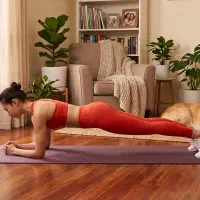
You get stronger by doing less per set, not more. Grease the groove, coined by Pavel Tsatsouline in his 2003 book The Naked Warrior, means practicing one bodyweight movement frequently throughout the day at submaximal effort, always fresh, never to failure. Strength is a skill, and skills are built by frequent quality practice, not by exhaustion.
Stop training to failure
The fastest way to understand grease the groove is to invert the usual advice and look at what it tells you to stop doing.
Stop training to failure. Stop chasing the burn. Stop treating soreness as the proof that a session worked. Stop cramming all your effort into two or three brutal sessions a week. Most of what fitness culture sells as the path to strength is, by this method’s logic, the obstacle. Fatigue is not the goal. Fatigue is the tax you pay, and grease the groove is built to avoid paying it.
What remains when you remove failure from the picture is surprisingly simple. You practice a movement often. You keep every rep clean. You stop long before you are tired. Then you come back and do it again later. The strength comes from the frequency and the quality, not from the suffering. Once you see that the suffering was never the active ingredient, the method stops sounding strange and starts sounding obvious.
The method and where it came from
Grease the groove was coined and popularized by Pavel Tsatsouline, a former Soviet special forces instructor who introduced kettlebell training to the West and founded the strength education company StrongFirst. He laid out the method in his 2003 book The Naked Warrior, where greasing the groove sits alongside his central claim that strength is a neurological skill.
The protocol is specific. Practice a movement frequently, at submaximal effort, staying fresh, never going to failure. Pavel Tsatsouline’s rule of thumb is to do about half the reps you are capable of, but no more than five per set, roughly 30 to 40 percent of your maximum. Leave substantial rest between sets, in practice by spreading them across the whole day. High frequency plus low fatigue produces a large volume of quality reps, and that quality volume is what drives the strength gain.
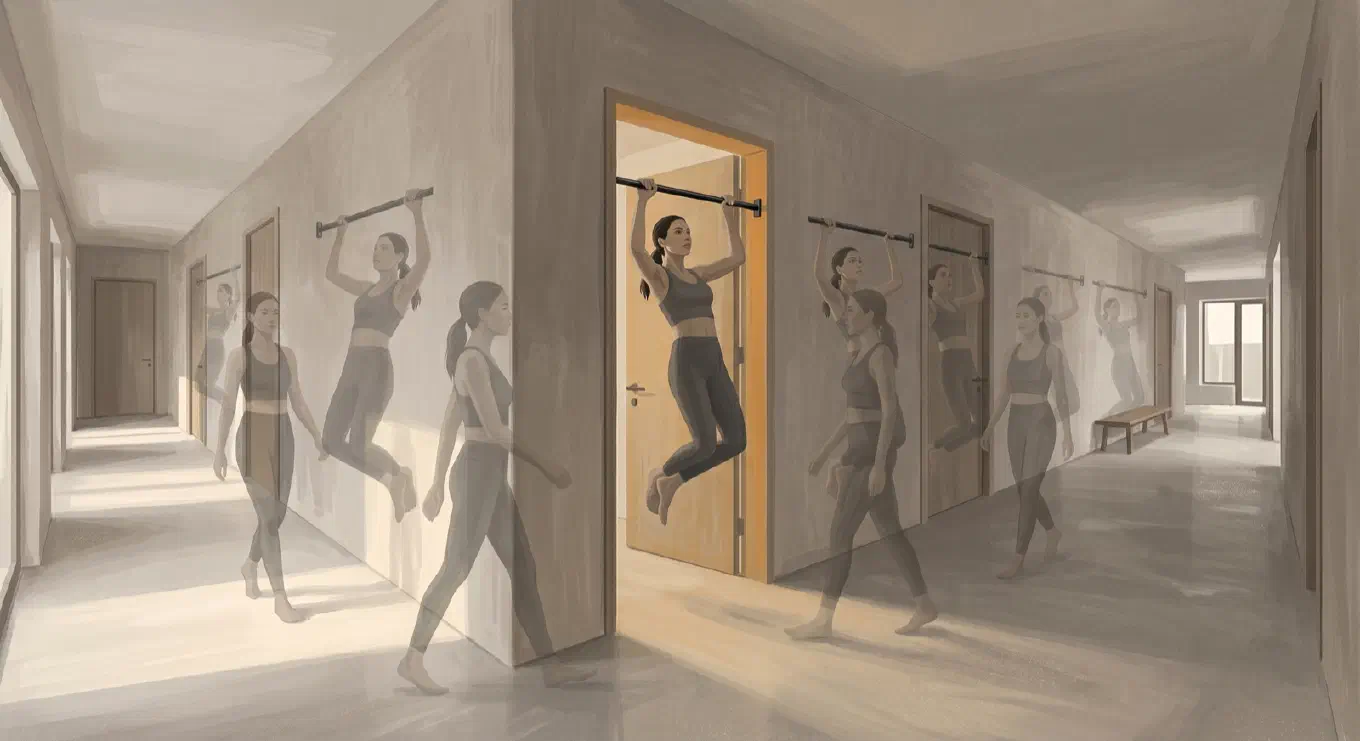
The canonical example is the doorway pull-up bar. You hang a bar in a doorway you walk through often, and as StrongFirst puts it, “each time you pass the bar throughout the day, perform one good rep.” Over a day you accumulate dozens of crisp, fresh pull-ups without a single hard set. The same logic generalizes to any bodyweight move. Push-ups by your desk. Squats while the kettle heats. A set of lunges between tasks.
One more rule keeps it from sprawling. Pavel Tsatsouline recommends working no more than two movements at a time. Spread your focus across five lifts and none of them gets the frequency it needs. Pick one or two, practice them relentlessly, and let the rest wait.
Why doing less per set works better
The reason grease the groove works is that early strength is mostly a brain adaptation, not a muscle adaptation. When an untrained person starts lifting, the first gains come from the nervous system learning to produce force more efficiently, long before the muscle visibly grows.
A 2020 review in the European Journal of Applied Physiology, The knowns and unknowns of neural adaptations to resistance training by Jakob Skarabot, Callum Brownstein, Andrea Casolo, Alessandro Del Vecchio, and Paul Ansdell, states that the initial increases in force production, within the first two to four weeks, are thought to be primarily underpinned by neural adaptations. The specific mechanisms include lowered motor unit recruitment thresholds, increased motor unit firing rates, improved coordination across the muscles involved, and reduced cortical demand to produce the same force. The muscle is not bigger yet. The nervous system has simply gotten better at driving it.
This is why submaximal frequency beats exhaustion for building strength. If strength is a motor skill, it improves the way any motor skill improves, through frequent, deliberate, high-quality practice. A pianist does not learn a passage by playing it once until their hands cramp. They play it cleanly, many times. Training to failure adds fatigue, and fatigue degrades the very thing you are trying to practice. Tired reps are sloppy reps, and sloppy reps train the wrong pattern. StrongFirst’s instructors are explicit about this. They would rather see you do quality single reps than multiple reps done poorly, because focusing on single reps automatically raises your percentage of quality reps. Freshness is not a comfort. It is a requirement for the adaptation you want.
How grease the groove differs from exercise snacking
Grease the groove and exercise snacking look almost identical from across the room. Both scatter small bits of movement through the day instead of bundling everything into one session. It is easy to assume they are the same idea with two names. They are not.
Exercise snacking is about health and longevity. The goal is the cardiometabolic benefit of brief, frequent bouts of activity, the kind that improves health markers regardless of whether you ever get stronger. The unit of success is your health.
Grease the groove is about strength and skill acquisition. The goal is to get better at a specific movement by practicing it often while fresh, so the nervous system encodes it as a stronger pattern. The unit of success is your one-rep strength on that lift. You could snack on exercise all day and never get measurably stronger at pull-ups. You grease the groove precisely to get stronger at pull-ups. Same shape, different target. Knowing which one you are doing tells you how to do it. Snacking rewards variety and elevated effort. Greasing the groove rewards focus, repetition, and staying easy.
How to actually do it
Greasing the groove is easy to start and easy to overdo, so the instructions are mostly about restraint.
Pick one or two movements. From the bodyweight basics, choose one or two to focus on, for example push-ups and squats, or pull-ups alone. More than two and the frequency thins out.
Find your easy number. Take roughly half your max for that movement, capped at about five reps. If your best is 20 push-ups, your working set is around 8 to 10. If your best is 6 pull-ups, your set is 3. It should feel almost too easy. That is correct.
Do that set many times across the day. Anchor each set to something you already do. Push-ups before a meeting. Squats while waiting for coffee. A set every time you walk past a doorway. By evening you have stacked a dozen clean sets without a single hard one.
Never go to failure, and keep form perfect. The moment a rep gets ugly, you have done too many. Stop with reps in the tank. Quality is the whole point.
Progress by frequency, not by grinding. When the work feels easy, add sets or add a daily touchpoint, not a death-march set at the end. Strength climbs because you practiced more often, not because you suffered more.
The hardest part is psychological. Doing a few easy reps and walking away feels like cheating, especially if you grew up believing a workout has to hurt to count. It does not. The accumulation is the work.
Where Kountrain fits
Kountrain is built for exactly this behavior, because grease the groove lives or dies on frictionless, frequent logging. The method only works if you can record a quick set anywhere, anytime, without ceremony. Open the app, tap the exercise, log the reps, close it. Open. Tap. Log. Done.
The six built-in exercises it tracks, push-ups, squats, planks, burpees, pull-ups, and lunges (and you can add your own with Premium), are ideal grease-the-groove movements. No equipment, no setup, do them anywhere. The daily rep goal turns scattered submaximal sets into a visible accumulation of quality volume, which is the entire premise of the method. The streak reinforces the daily frequency that grease the groove depends on, since the strength comes from showing up many times, not from one hard effort. The per-exercise form guides, with proper technique, tips, and common mistakes, support the quality-reps requirement that makes the neural adaptation work. And Pavel Tsatsouline’s rule of no more than two movements at once maps cleanly onto picking a couple of the six and ignoring the rest.
The core is free. No account, no internet, no subscription. Custom exercises are a one-time Premium purchase. Everything runs offline and your data stays on your device in a local database. You can export your entire history as a spreadsheet whenever you want. The app does not get in the way of the method, which is the point.
Kountrain is available on the App Store and Google Play.