Six bodyweight exercises give you broad, balanced strength with almost no equipment: push-ups, pull-ups, squats, lunges, planks, and burpees. Together they train pushing, pulling, squatting, single-leg work, core bracing, and conditioning. This guide covers what each one trains, how to do it with good form, the most common mistakes, and how to scale it up or down. These are also the six built-in exercises in Kountrain, each shipping with its own form guide.
Why these six
Most full-body coverage comes down to a handful of movement patterns: push, pull, squat, single-leg, brace, and condition. Push-ups cover the horizontal push. Pull-ups cover the vertical pull. Squats and lunges cover the legs, with lunges adding single-leg balance that a two-legged squat skips. Planks train the core to resist movement, which is what the core does in real life. Burpees stitch several patterns together and add conditioning. Six movements, no gym, and you have touched almost everything.
Almost. It is worth being honest about the gap, because overclaiming “whole body” is how fitness marketing loses your trust. Two patterns stay under-trained with bodyweight alone: a loaded hip hinge (the deadlift pattern that builds the posterior chain) and a horizontal pull (a row). As Breaking Muscle’s coaches put it, bodyweight training “lacks an effective way to train the hinge movement” without added load. You can partly fill both with a resistance band, inverted rows under a sturdy table, and a hip-hinge movement, and we note where below. But the core six are a large, balanced step forward for anyone doing nothing structured today.
A note before the movements. Warm up for a few minutes first. Progress gradually, adding difficulty only when the current version feels clean and easy. And if you have an injury or a medical condition, talk to a physiotherapist or doctor before starting. None of this is a substitute for professional advice.
Push-ups
What it trains. The push-up is the horizontal push. EMG research finds the prime movers are the pectoralis major, triceps brachii, serratus anterior, and anterior deltoid, with the core working as a stabilizer to keep your body rigid. It is the most accessible upper-body strength builder there is, because the floor is the only equipment.
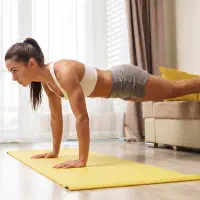
How to do it. Hands on the floor directly under your shoulders, fingers pointing forward, shoulder-width apart. Extend your legs back into a plank with a straight line from head to heels. Lower your chest toward the floor with your elbows tracking back at roughly 45 degrees, not flaring straight out to the sides. Press back up to full lockout. Exhale on the way up, inhale on the way down.
Common mistakes. Elbows flaring to 90 degrees, which stresses the shoulders, keep them around 45. Hips sagging toward the floor, squeeze your glutes before you start so your body stays one rigid line. Half reps, your chest should nearly touch the floor every time. Fingers pointing inward, point them forward to keep your wrists neutral.
Make it easier. Raise your hands. Incline push-ups against a kitchen counter or wall reduce the load instantly, and you can lower the surface as you get stronger. Knee push-ups are the next step down from full push-ups. Both let you train the exact movement with less of your body weight.
Make it harder. Lower your hands or remove one. Decline push-ups, with feet elevated on a chair, shift more load to the shoulders and upper chest. Archer push-ups push most of the weight onto one arm. The one-arm push-up is the endpoint. Narrowing your hands into a diamond also raises the difficulty by loading the triceps more.
Pull-ups
What it trains. The pull-up is the vertical pull, and the one movement here that needs a bar. EMG research on the pull-up identifies the latissimus dorsi and biceps brachii as the primary movers, with grip and forearm muscles working hard to hold the bar. It builds the back and arms in a way no other bodyweight move matches.
How to do it. Grab the bar with palms facing away, hands about shoulder-width apart. Hang with arms fully extended and shoulder blades pulled down and back. Pull yourself up until your chin clears the bar, thinking about driving your elbows toward your hips rather than yanking your chin up. Lower yourself slowly until your arms are fully straight again.
Common mistakes. Kipping or swinging to generate momentum, if you need the swing, you are not ready for a strict rep yet. Starting each rep with bent arms instead of a full dead hang. Shrugging your shoulders to your ears, pull your shoulder blades down before you pull your body up. Craning your neck to clear the bar, aim to bring your upper chest toward it, not your forehead.
Make it easier. Build the pull in stages. A dead hang for 30 seconds builds grip. Negatives are the key drill: jump or step to the top, then lower yourself under control over about 5 seconds, building to sets of 5. A resistance band looped over the bar and under your knee assists the bottom of the rep. Inverted rows, lying under a low bar or sturdy table and pulling your chest up, train the same pulling muscles horizontally and double as the horizontal-row pattern the other five exercises miss.
Make it harder. Slow the tempo, pause at the top, or add reps. Beyond that, the archer pull-up shifts load toward one arm, and the one-arm pull-up is the long-term goal. Weighted pull-ups, with a backpack, raise the difficulty without changing the movement.
Squats
What it trains. The bodyweight squat is the fundamental lower-body pattern, training the hip extensors and knee extensors, your glutes and quads, with the core stabilizing the trunk. A biomechanical review found gluteus maximus activation increases roughly 65 percent going from a shallow to a medium-depth squat, which is a concrete reason to hit real depth rather than quarter-squatting.
How to do it. Stand with feet shoulder-width apart, toes turned out 15 to 30 degrees. Push your hips back and bend your knees at the same time. Lower until your hip crease is at or below your knees. Drive through your full foot to stand back up and lock out your hips at the top. Inhale and brace your core before each rep, exhale at the top.
Common mistakes. Knees caving inward, push them out to track over your toes. The same biomechanical review notes that rotating the feet outward about 30 degrees has been reported to reduce the inward (valgus) load at the knee by half. Rising onto your toes at the bottom, try a wider stance or elevate your heels slightly. Rounding the lower back, keep your chest up and your eyes on a fixed spot ahead. Cutting depth short, if your hip crease never reaches your knees, it is not a full rep.
Make it easier. Squat to a chair or box. Lowering until you tap a seat and standing back up removes the balance and depth demand, and you can use a lower seat as you improve. Holding a doorframe or TRX strap for light support lets you work the pattern while you build strength.
Make it harder. Slow the descent, pause at the bottom, or progress toward single-leg work. The pistol squat, a full squat on one leg, is a major step up in strength and balance. Jump squats add power and conditioning. A backpack full of books turns the bodyweight squat into a loaded one.
Lunges
What it trains. The lunge is single-leg strength and balance, training the quads and glutes one leg at a time while challenging your stability in a way two-legged squats do not. Stepping forward and back also trains the hip stabilizers that keep your knee tracking properly. It exposes and fixes left-to-right strength imbalances that a barbell or bodyweight squat can hide.
How to do it. Stand tall with feet hip-width apart. Step forward with one leg, roughly two feet out. Lower your back knee toward the floor until both legs are bent to about 90 degrees, keeping your front shin close to vertical. Drive through your front heel to return to standing. Alternate legs each rep, staying upright with your eyes on a fixed point at eye level.
Common mistakes. Front knee collapsing inward, actively push it out over your pinky toe. Torso leaning forward, stay tall. Steps too short, so your back knee never drops low enough, step further than feels natural. Pushing off the back foot to stand, drive through the front heel only, that is where the work belongs.
Make it easier. Reverse lunges, stepping backward instead of forward, are gentler on the knees while training the same muscles. Holding a wall or chair for balance removes the stability demand so you can focus on strength. Shortening the range of motion at first is fine.
Make it harder. Walking lunges add continuous movement. Jumping lunges, switching legs in the air, add power and conditioning. The Bulgarian split squat, with your back foot elevated on a chair behind you, loads the front leg heavily and is one of the best single-leg strength builders you can do without weights. A backpack adds load to any of these.
Planks
What it trains. The plank trains the core to resist movement rather than create it, which is the core’s real job: keeping your spine stable while your limbs work. EMG research shows the front plank recruits the rectus abdominis and the obliques, the muscles that brace your trunk. Unlike sit-ups, it trains stability under load, which carries over to push-ups, squats, and everyday lifting.
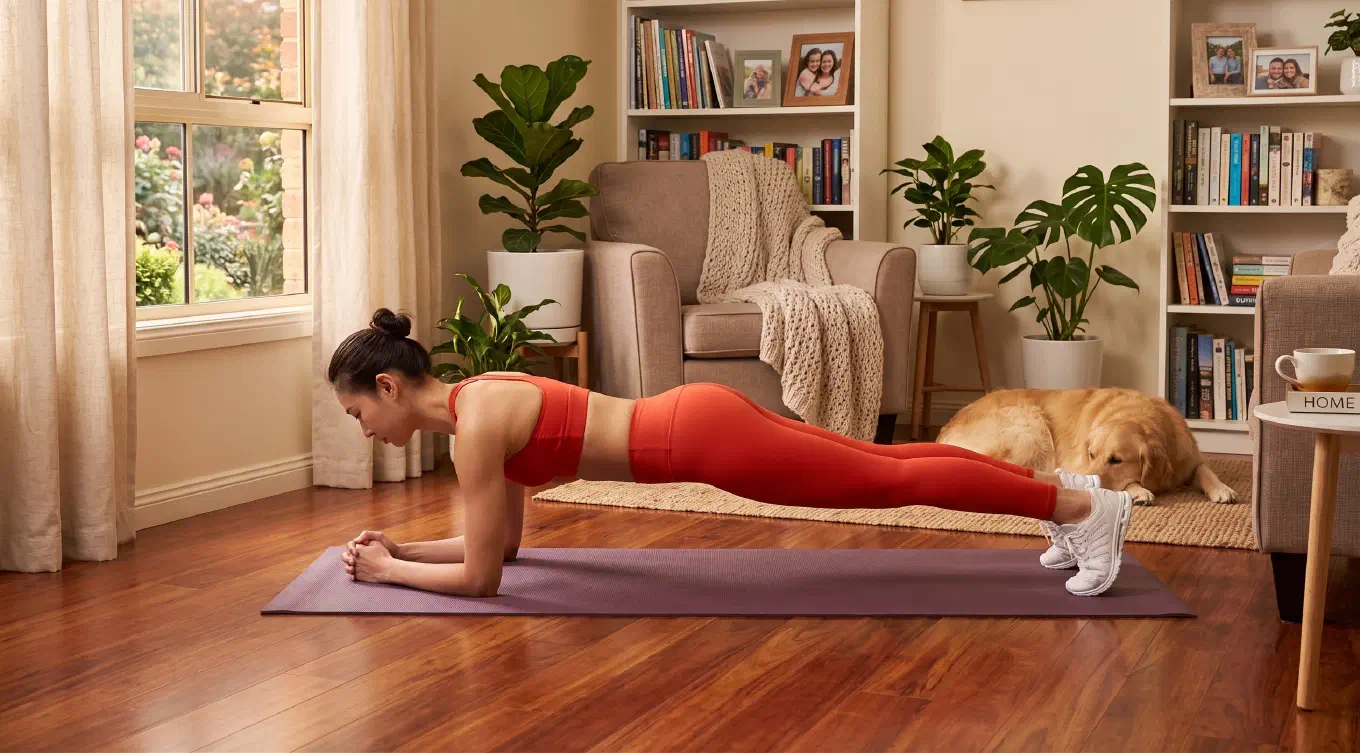
How to do it. Place your forearms flat on the ground, elbows directly under your shoulders. Step your feet back and balance on your toes. Squeeze your glutes and brace your core. Hold a straight line from head to heels. Breathe in through your nose and out through your mouth the entire time. Press your forearms into the floor as if pushing it away from you.
Common mistakes. Hips dropping low, tilt your pelvis slightly toward your ribs to level out. Hips piking up above shoulder level, think “long spine,” not “tent.” Holding your breath, keep breathing the whole time. Elbows too far forward, they belong directly beneath your shoulder joints. Squeezing your quads hard takes load off your lower back.
Make it easier. Drop to your knees. A knee plank keeps the exact bracing demand with less of your body weight to support. An incline plank, forearms on a couch or bench, is even gentler. Start with 20 seconds and add 5 seconds per session, not per week.
Make it harder. A long-lever plank, walking your elbows further forward of your shoulders, sharply increases the demand on your abs. The RKC plank, where you maximally squeeze everything (glutes, quads, abs) for a short, intense hold, makes even 10 seconds brutal. Lifting one foot or one arm adds an anti-rotation challenge.
Burpees
What it trains. The burpee is the conditioner. It combines a squat, a plank, a push-up, and a jump into one explosive rep, so it trains the whole body while spiking your heart rate. It was invented in 1939 by the US physiologist Royal Huddleston Burpee, who used it as a quick fitness test. It is the one movement here that doubles as cardio, which is why a few minutes of burpees leaves you breathing hard.
How to do it. Stand with feet hip-width apart. Drop into a squat and place both hands flat on the floor. Jump or step your feet back to a plank position. Do a push-up with your chest to the floor. Jump your feet back to your hands and explode upward with your arms overhead. A good rep ends with full hip extension and your feet leaving the ground at the top. Pick a breathing rhythm and protect it: inhale standing, exhale in the plank.
Common mistakes. Skipping the push-up, if you are counting burpees, the chest should hit the floor. Landing with locked knees, land soft on the balls of your feet with knees slightly bent. Losing the plank, your hips should not sag when you jump back. Rushing without resetting, pause for one breath at the top if your form starts breaking down.
Make it easier. Step back instead of jumping, the rep still counts. Removing the push-up, the jump, or both turns it into a squat thrust, the gentler original version. Slowing the pace down keeps your form intact while you build conditioning.
Make it harder. Add a tuck jump or a knee-to-chest at the top. The burpee pull-up, jumping straight into a pull-up if you have a bar overhead, raises the difficulty sharply. Stringing them together for time, fast and clean, is its own challenge.
How the six fit together
Done across a week, these six cover the patterns that matter. A simple approach: pick push-ups and squats one day, pull-ups (or inverted rows) and lunges another, planks most days, and burpees when you want conditioning. The WHO recommends muscle-strengthening activity for all major muscle groups on 2 or more days a week, alongside aerobic activity, and these six clear that bar easily.
If you want to get stronger rather than just stay active, frequency beats intensity. Practicing a movement often at submaximal effort, fresh and never to failure, builds strength faster than a few brutal sessions because early gains are largely neural. We cover the method in Grease the Groove. And if the hard part is starting at all, the fix is rarely more willpower. It is making the first rep small enough to be impossible to refuse.
To round out the two gaps, add a band or a row. A resistance band pull-apart and inverted rows train the horizontal pull. A banded good morning or a single-leg Romanian deadlift trains the hip hinge. Neither needs a gym.
How Kountrain logs and guides them
Kountrain ships with exactly these six exercises built in: push-ups, pull-ups, planks, burpees, squats, and lunges. Push-ups, pull-ups, burpees, squats, and lunges are logged in reps. Planks are logged in seconds, because a held position is measured in time, not count. Each of the six includes a built-in form guide with the proper technique, tips, and common mistakes, the same guidance distilled in this article, so the cues are in your pocket while you train.
You set a daily rep goal and log throughout the day. Open the app, tap the exercise, log the set, done. Streaks track consecutive days, achievements unlock at milestones, and a rough MET-based calorie estimate gives you a sense of effort. Why the counting itself changes the behavior is its own subject, covered in Why Counting Reps Matters.
Everything works offline, with no account, in your language. Your data stays on your device in a local SQLite database, and you can export your full history as a spreadsheet anytime, for free. The core is free forever. A one-time Kountrain Premium purchase, no subscription, unlocks custom exercises if you want to add movements beyond the six, including the rows and hinges that fill the gaps above.
Kountrain is available on the App Store and Google Play.