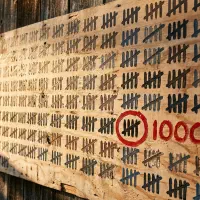
You start working out by making the workout so small it feels almost pointless. Ten push-ups. That is the entire first day. Behavioral science is clear on this: the people who successfully build exercise habits are not the ones who start strong. They are the ones who start small enough to never stop.
The reason you haven’t started
You already know exercise is good for you. Everyone does. That knowledge has been available for decades, and it has not gotten you off the couch. This is not a willpower problem. It is an intention-action gap, and psychologists have studied it extensively.
A meta-analysis published in the British Journal of Health Psychology found that intention predicts only 30 to 40 percent of the variation in health behavior. Roughly half of people who intend to exercise do not follow through. The gap between wanting to exercise and actually doing it is nearly at chance.
The reason is structural. Your brain evaluates the cost of an action against its immediate reward. A 45-minute workout has a high cost (effort, time, discomfort) and a delayed reward (health benefits you cannot feel today). Watching something on your phone has zero cost and an immediate reward. Your brain is not broken. It is doing exactly what brains do.
The fix is not more motivation. Motivation fluctuates. It is high on January 1st and gone by January 19th. Researcher Katherine Milkman at Wharton found that gym attendance spikes 47% at the start of a new semester and 50% at the start of a new year. Then it drops. The people who relied on motivation to start are the same people who stop when it fades.
The smallest possible workout
BJ Fogg, who directs the Behavior Design Lab at Stanford, has spent two decades studying how habits form. His central finding: make the behavior tiny. Not “start small and work up to something real.” Tiny. As in, do two push-ups after you use the bathroom. That is the entire habit.
This sounds absurd. It is supposed to. The point is not the push-ups. The point is the wiring. Fogg’s research shows that habit formation is not a function of repetition. It is a function of emotion. When you complete a behavior and feel a small sense of success, that feeling wires the behavior into your brain. You do not need 30 days. You need one genuine moment of “I did it.”
The critical insight: keep the bar low and do not raise it. “What you need to do in the tiny habits method is set the bar low, keep it low, overachieve whenever you feel like it, but don’t raise the bar,” Fogg says. This contradicts everything fitness culture teaches. Fitness culture says progress means doing more. Behavioral science says progress means not stopping.
Why 10 push-ups
There is a reason push-ups are the right starting point, and it is not symbolic.
A 2019 study published in JAMA Network Open followed 1,104 male firefighters for 10 years. Men who could complete 11 or more push-ups had a 64% lower risk of cardiovascular disease events compared to those who could do fewer than 10. Those who could do more than 40 had a 96% reduction in risk. Push-up capacity was a stronger predictor of cardiovascular health than a treadmill stress test.
The study has limitations. The subjects were active men, and the results may not generalize to women or sedentary populations. But the signal is clear: push-up ability is a meaningful proxy for cardiovascular fitness. And the threshold for the first significant risk reduction, going from under 10 to over 10, is remarkably low.
Ten push-ups is not a warmup. It is a real data point about your health.
The identity shift
James Clear describes an idea that research in behavioral psychology supports: the most durable habits are identity-based. You do not start by setting a goal (“I want to do 100 push-ups”). You start by casting a vote for the person you want to become (“I am someone who exercises”).
This is not affirmation nonsense. A study published in Psychology of Sport and Exercise found that exercise identity was the strongest correlate of translating physical activity intentions into action (d = 0.73). Stronger than planning. Stronger than self-efficacy. When people see themselves as “someone who exercises,” the behavior follows.
The mechanism is simple. People learn about themselves the same way they learn about others: by watching what they do. If you did 10 push-ups today, you have evidence. Not aspirational evidence. Actual evidence. You are someone who did push-ups today. Do it again tomorrow and the evidence doubles. The identity is not a precondition. It is a consequence of the behavior.
Another study, published in the Annals of Behavioral Medicine, found that women who completed a 16-week exercise program developed stronger exercise identities, and those whose identity shifted the most were the most likely to still be exercising 6 months later. The habit created the identity. The identity maintained the habit.
What you are actually fighting
Fifty percent of people who start an exercise program drop out within six months. A study of 5,240 fitness club members in Brazil found that 63% abandoned their membership in the first quarter. The primary predictor of dropout: starting with more than you can sustain.
The fitness industry is optimized for selling ambition. 12-week transformations. 30-day challenges. Programs that assume you will show up five days a week for an hour. These programs are not designed for you. They are designed for people who already exercise and want to exercise differently.
You are fighting something more basic. Albert Bandura called it self-efficacy: the belief that you can succeed at a specific task. If you have never maintained an exercise habit, your self-efficacy for exercise is low. And the research is clear: self-efficacy is the most consistent predictor of whether someone will continue a health behavior.
Bandura identified the strongest source of self-efficacy: mastery experiences. Succeeding at something, even something small, builds the belief that you can succeed again. This is why the tiny workout matters. Not because 10 push-ups will transform your body. Because 10 push-ups you actually did transforms your belief about what you are capable of doing tomorrow.
The compound math of small numbers
Ten push-ups a day is 3,650 push-ups a year. That sounds like a lot. It is a lot. But it does not feel like a lot on any given day, which is exactly the point.
This is the same principle behind exercise snacking, short bursts of movement spread throughout the day. Research on vigorous intermittent lifestyle physical activity (VILPA) has shown that as little as 3.5 minutes of vigorous activity per day is associated with meaningful reductions in cancer and cardiovascular risk. The threshold for real health benefit is far lower than the fitness industry implies.
But this post is not about the health math. The exercise snacking post covers that. This post is about the psychological barrier: the belief that unless you do a “real” workout, it does not count.
It counts. The research says it counts. And more importantly, the act of counting it, logging it, seeing the number, is what makes the habit stick.
Why tracking changes the equation
Wendy Wood, a habit researcher at USC, found that approximately 43% of daily behaviors are performed out of habit, meaning they are automatic responses triggered by context rather than conscious decisions. The goal is to move exercise from the “decision” category to the “automatic” category. Tracking accelerates that transition.
When you log 10 push-ups, three things happen. First, the behavior becomes visible. You can see that you did it. This matters because small efforts feel invisible without a record. Second, the behavior becomes cumulative. You see 70 this week. 300 this month. The accumulation is motivating in a way that any single session is not. Third, the behavior becomes a streak. And a streak is something you protect.
This is where gamification becomes useful, not as entertainment, but as a feedback loop that makes invisible progress visible.
Kountrain is built for this. You open the app, tap the exercise, log your reps, and close it. Five seconds. It tracks your daily total, your streak, and your lifetime count. It has 56 achievements that unlock as you cross milestones. You did your first workout. You hit 100 push-ups total. You maintained a 7-day streak. These small events create exactly the mastery experiences that Bandura’s research identifies as the foundation of self-efficacy.
No account required. No setup. No subscription. The app works offline and keeps your data on your device. Everything is free. Available on iOS and Android.
The actual plan
Here is what to do today.
Do 10 push-ups. If 10 is too many, do 5. If you cannot do a standard push-up, do them from your knees or against a wall. The number does not matter. What matters is that you finish and it was not hard enough to discourage you.
Log it. In an app, in a notebook, in a text file. The medium does not matter. The act of recording it does.
Tomorrow, do it again. Same number. Do not increase it. BJ Fogg is explicit about this: do not raise the bar. If you feel like doing more, do more. But the commitment is 10. Only 10. For weeks if necessary.
At some point, you will do more. Not because a program told you to. Because you want to. That is the moment the habit has taken hold. That is the identity shift happening in real time. You are no longer someone who is trying to start working out. You are someone who does push-ups.
That shift, from trying to being, is the entire game.