To hold a plank longer, fix your technique before you train harder. Bracing your whole body evenly, stacking your elbows under your shoulders, keeping a straight line from head to heels, and breathing steadily can add real seconds today. Then build endurance with small, progressive increases. Aim for a clean two minutes, then stop chasing time.
That last part matters, so read past the technique. There is a real ceiling on this, and knowing where it sits will save you from wasting months on the wrong goal. First the seconds you can win now, then the endurance you can build, then the point where longer stops paying.
Why your plank fails before your core does
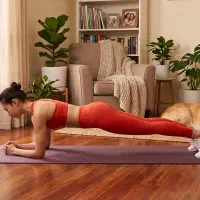
Most planks end from form breakdown, not from a truly exhausted core. Watch anyone hold a plank to failure and the collapse follows a pattern. The hips drift down, the lower back arches and takes over the work, the breathing gets held and shallow, and the straight line from head to heels quietly falls apart. The core was not finished. The position was.
This is good news, because it means the fastest way to hold longer is not more suffering, it is stopping the leak. A plank is a bracing task, and the whole point is to keep your torso rigid against gravity. When your form drifts, the brace stops doing its job and the seconds you lose were never a strength problem. A smaller group of people hold a genuinely clean plank and simply run out of core endurance. That is the honest limit, and it is the thing that responds to training. Everything below sorts the two out: fix the leaks first, then train the real ceiling.
Fix the leaks: technique that adds seconds now
If your plank collapses early, these four corrections often add real seconds the same day. None of them is about trying harder. They are about spending your effort where it counts.
Stack your elbows under your shoulders. The plank is a lever, and the longer the lever, the more your abs have to fight. Elbows placed forward of your shoulders lengthen that lever and pile on load with every centimeter. Set your elbows directly beneath your shoulder joints and the same core does less work, so it lasts longer.
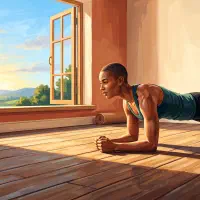
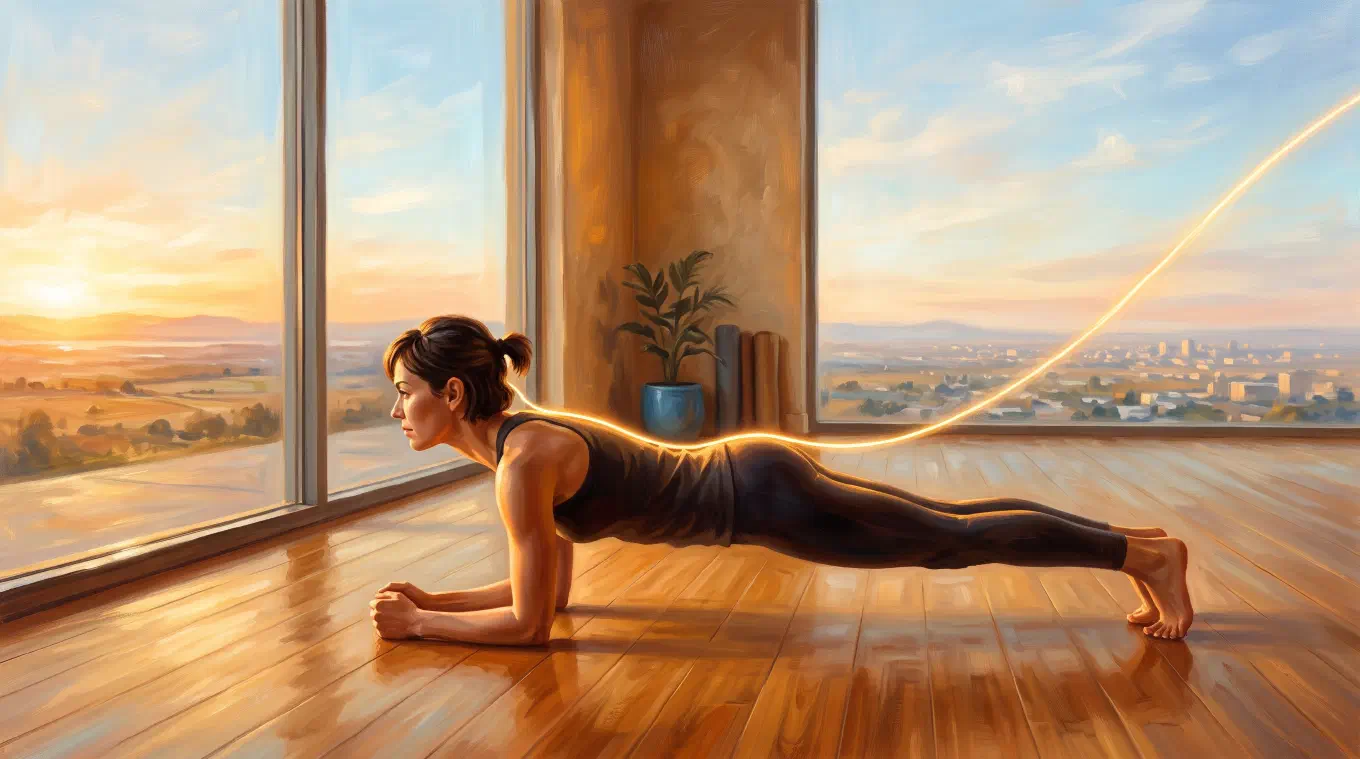
Hold one straight line, head to heels. Two failures cost you time. Sagging hips dump the load onto your lower back, which feels like effort but is not core training, it is spinal strain. Piking your hips up into a tent takes the abs off tension so the clock keeps running while nothing is happening. Aim for a long, flat spine. Tilt your pelvis slightly toward your ribs to kill the sag, and think “long,” not “high.”
Brace evenly, do not max out. Squeezing every muscle as hard as possible makes a plank brutal and short. That is a tool for later. To hold longer right now, you want a firm, even, sustainable brace you can keep for the whole hold, not an all-out clench that empties the tank in twenty seconds. Light your glutes and quads enough to protect your lower back, then hold that steady.
Breathe the whole time. A plank is an isometric hold, but your muscles still burn oxygen the entire time, so steady breathing is what lets you sustain the position. Discussing planks and isometric exercise, the British Heart Foundation puts it plainly: you must remember to breathe. Breath-holding brings on premature fatigue and, during a static contraction, spikes your blood pressure in the moment. Breathe in through your nose and out through your mouth at a calm, even pace. Do not hold your breath to squeeze out extra seconds.
Train the endurance: how to actually add minutes
Once your form is clean and your plank still tops out short, you have found the real limit, and the real limit responds to training. Two rules do most of the work.
Add time in small steps. Increase your hold by a few seconds each session, not in giant leaps. Small increments keep the position clean as the number climbs, and a clean two minutes is worth far more than a sloppy three. Big jumps just reintroduce the sag you spent the last section fixing.
Bank total time with repeated short holds. You do not have to reach two minutes in a single grind to train two minutes of endurance. Spine researcher Stuart McGill, who spent three decades studying spine biomechanics at the University of Waterloo, recommends repeated short holds of about ten seconds over one long hold for the average person. The logic scales: three sets of forty seconds gives you two minutes of full-tension work while your form stays crisp, and you accumulate more quality than a single long hold, which spends its final stretch in slow decay. This is the same idea behind greasing the groove: frequent, fresh practice beats occasional exhaustion. Full form cues and regressions for the plank live in our guide to the six bodyweight exercises.
Aim for two clean minutes, then stop chasing time
Here is the honest ceiling. Strength coach Dan John’s widely cited benchmark is that a fit, healthy person should manage a two-minute plank, and past two minutes there is nothing left to gain. His words: “Enough is enough. It’s just a plank. More is not better.” Two minutes is also above the average recorded in the largest published norms study, where 471 college students held a forearm plank to failure and men averaged 124 seconds, women 83.
So getting from forty-five seconds to two clean minutes is real, worthwhile work. Getting from two minutes to five is mostly a demonstration that you can tolerate discomfort, which is a skill, but not the one you started planking for. Once two minutes is easy, the productive move is not a longer hold, it is a harder one. Squeeze everything at once, walk your elbows forward to lengthen the lever, or lift a foot or a hand to turn the plank into an anti-rotation exercise. Each drops you back to short holds at full tension, which is where the training lives. We cover why harder beats longer, and what the world record actually proves, in how long should you hold a plank. Make the plank harder, not longer.
Time every hold, or you are guessing
You cannot tell whether your technique fixes are working, whether you are inching toward two minutes, or whether a harder variation really is shorter, unless you time your holds and write them down. Untimed planks all feel the same. Timed planks show a line going up.
This is what Kountrain is for. The plank is one of its six built-in exercises and the only one logged in seconds rather than reps, with a built-in timer screen for the hold and a form guide in your pocket. Set a daily seconds goal, log each hold, and watch your streaks, records, and totals build. It works offline, needs no account, and the core is free with no subscription. Your data stays on your device, and if the six built-in exercises are enough, you never pay.
Kountrain is available on the App Store and Google Play.