Trazu and Adobe Fresco both simulate real paint, not just its look: a brush that runs dry, color that blends wet into wet. Fresco is free, tied to a required Adobe account, and runs on iPad, iPhone, and Windows. Trazu is a one-time purchase, works fully offline with no account, and runs on iPhone, iPad, Mac, and Android. Here is where the two honestly agree and disagree.
Two companies made the same bet: paint should behave, not just look real
Most digital painting apps still work the way they did fifteen years ago. You pick a color, drag a textured brush, and the stroke is identical from the first pixel to the last. What made Adobe Fresco notable when it launched, and what Trazu is built around from the ground up, is a rejection of that model. Adobe’s own product page describes Fresco’s “AI powered Live Brushes” that “bloom, blend, and smudge like the real thing.” Trazu’s tagline is blunter: “Real paint. No mess.”
That both a large software company and a focused painting app converged on the same idea, simulate the behavior of paint rather than a picture of it, is worth noticing. It means the demand for this is real, not a gimmick either company invented to sell an update. It also means the interesting question in this comparison is not which app is more “realistic.” Both are. The interesting question is what each company built around that shared bet, because that is where they pull apart completely.
What “free” actually means in each app
Adobe scrapped Fresco’s old Premium subscription and made the app free for everyone, live brushes included. That is a genuinely good deal: thousands of brushes, unlimited layers, and animation, at no cost. But free in Fresco does not mean account-free. Getting started requires a free Adobe ID, and Adobe’s own guidance has you sign back in roughly every 30 days to keep your license valid, on top of signing in to download or update the app. Fresco does let you flag files as available offline, syncing once you reconnect, but the app’s identity, your license, and your cloud storage all live behind that Adobe account. The free plan caps that cloud storage at 5GB; paid Creative Cloud plans, priced from roughly $7.99 a month for a Fresco and Photoshop bundle up to $59.99 a month for the full Creative Cloud suite, raise that to 100GB and unlock premium Adobe Fonts. Creative Cloud pricing varies by country and changes over time, so treat those figures as the ballpark to check in Adobe’s own pricing page rather than a fixed number.
Trazu takes the opposite shape. There is no account to create, no email, no sign-in, ever, and no server to reach. The app works fully offline by default, not as an optional mode, because there is nothing in it designed to talk to a server in the first place. It is free to start, with the full paint engine and the core mediums and papers unlocked from the first stroke, and the free tier saves up to ten drawings. Trazu Premium is a single one-time purchase, yours for life, with no subscription of any kind, that unlocks unlimited drawings, four study views, transparent PNG export, and a shelf of master brushes and papers. Neither model is dishonest. They are just different answers to who is allowed to see your account and your files: Adobe, or nobody.
Platform: neither app covers every device, and they don’t overlap
This is the most practical difference, and it is a hard line rather than a preference. Adobe Fresco runs on iPad and iPhone, on Windows 10 and 11 devices including Surface tablets, and is also listed for Apple Vision. It has never shipped on Android, and Adobe’s own community forum has years of unanswered requests for one. It also does not run on Mac.
Trazu runs on iPhone and iPad, Mac, and Android. It has never shipped on Windows.
Put the two lists next to each other and there is exactly zero overlap on desktop, and only iPhone and iPad in common on mobile. If you paint on a Windows tablet, Fresco is your only option between these two. If you paint on an Android phone or tablet, or on a Mac, Trazu is yours. Neither app is trying to be dishonest about this; it is just where each company chose to build first, and neither has closed the gap.
Depth versus focus: layers and animation against a single surface and study views
Fresco is the deeper tool by a wide margin, and that is by design, not an accident. It offers unlimited layers, vector brushes that stay sharp at any zoom, frame-by-frame animation with motion paths, a symmetry tool, and file handoff into Photoshop or Illustrator on desktop. It can export to PNG, JPG, PSD, and PDF, and animated work to GIF, MP4, or a transparent ProRes video. For anyone building a layered illustration, a comic page, or a short animated piece, that toolkit is a real reason to choose it, for free.
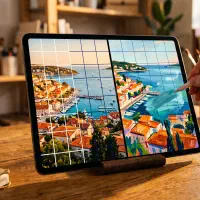
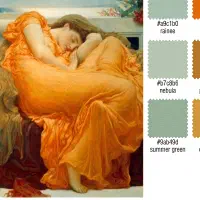
Trazu goes the other way on purpose. It has no layers, no vector tools, and no animation, and it exports to PNG and JPEG only, with transparent PNG behind the Premium upgrade. What it has instead, and what nothing in Fresco does, is four analysis lenses built directly into the canvas: Value, Temperature, Saturation, and Contrast. While you paint, you flip your own work in progress into any of them to check your light-dark structure, your warm-cool balance, or your color intensity, the same squint a painter gives a canvas from across the room, done for you, mid-stroke, while there is still time to fix what you see. Fresco has powerful filters and adjustment layers for after the fact. Trazu is built to catch the problem while you are still holding the brush.
How the two “physics” engines actually differ
Both apps simulate paint behavior, but not the same way, and the difference comes from a structural choice each company made. Fresco’s watercolor live brushes bloom color into adjacent areas and stay wet for blending, and its oil live brushes swirl and mix colors that, unlike real oil, never dry, so you can keep remixing them even after closing and reopening a file. That mixing happens on whichever layer you are painting on, because Fresco is a layered app and a layer is, by definition, its own surface.
Trazu’s brush carries a finite charge of pigment that depletes as you drag it, so a long stroke fades and breaks the way a real one runs dry. Drag through color already on the canvas and it lifts, smears, and mixes wet into wet, blended in the perceptually accurate Oklab color space rather than crude RGB averaging, and oil builds up thickly with real impasto ridges you can see. Because Trazu has no layers, that mixing happens across one continuous surface, the way an actual sheet of watercolor paper or a single oil-primed canvas does not care which “layer” your last stroke was on. Fresco’s oils stay wet forever by design, a deliberately non-physical convenience for editing. Trazu’s paint runs out, the way real paint does, because Trazu is chasing the feeling of a loaded brush in your hand, not infinite undo.
Who should choose which
Choose Fresco if you are on an iPad, iPhone, or Windows tablet, want a full illustration suite with layers, vector art, and animation, and do not mind an Adobe account and its cloud storage tier. It holds a 4.7 rating across roughly 61,000 App Store reviews, a track record Trazu, as a newer app, does not yet have. It is a legitimately excellent free app, and there is no honest reason to talk anyone with an iPad out of trying it.
Choose Trazu if you are on Android or Mac, where Fresco is not available at all, or if the Adobe account, the cloud sync, and the layered production-app depth are exactly what you do not want. Choose it if you want painting to feel physical from the first stroke, brush charge, wet-into-wet mixing, real paper grain, and if you want the four study views to teach you to see value, temperature, saturation, and contrast while the painting is still wet enough to fix. You give up layers, vector tools, and animation to get it. For a lot of painters, especially anyone who paints the way a traditional painter works on one surface rather than building an image in stacked parts, that is a trade worth making.
If you are weighing the wider field, see our roundups of the best simple drawing and painting apps and the best Procreate alternatives for Android, and our honest take on whether you need Procreate at all.
Try Trazu
Trazu is out now on iPhone and iPad, Mac, and Android. Free to start, no ads, no account, one lifetime purchase for the rest. Paint that behaves like paint, in your pocket.